
Air Classifier
Mill (ACM)
An integrated ultrafine milling system combining grinding, classification, conveying, and collection in a single unit. Achieve 100-500 mesh (40-100 µm) with precise, screen-free particle size control.

Product Overview
The YDWF Air Classifier Mill is engineered for industries where particle size precision, hygiene, and thermal sensitivity are non-negotiable.
Screen-Free Classification
Particle size is controlled by centrifugal force through an internal classifier wheel -- no screens to block, clean, or replace. Consistent output fineness across long production runs.
Ultrafine Milling Capability
Achieves finished fineness of 100-500 mesh (approximately 40-100 µm). Suitable for applications requiring fine and ultrafine particle distributions not achievable with standard hammer mills.
Integrated Classifier Wheel
The built-in air classifier continuously separates on-spec particles from oversized ones. Oversized particles are returned to the grinding zone -- minimizing over-grinding and improving yield.
Low-Temperature Grinding
Advanced air-cooling technology prevents heat buildup in the grinding chamber. Designed for heat-sensitive materials including APIs, certain pigments, and temperature-critical food ingredients.
Sanitary Grade Construction
All product-contact parts are stainless steel (SS304/SS316L available). Internal surfaces are polished to food-grade or GMP standards. Designed for easy disassembly and cleaning between batches.
Integrated System Design
Grinding, classification, pneumatic conveying, and dust collection are integrated into one compact system. Reduces footprint, simplifies operation, and improves overall material recovery efficiency.
Working Principle
The ACM combines mechanical impact grinding with inter-particle friction and continuous air classification in a closed-loop process. Only particles meeting the target size exit the system.
Material Feeding
Material (feed size ≤15 mm) enters the grinding chamber through the feed inlet. A controlled feed rate ensures stable operation and consistent particle size output.
Airflow Conveying
Induced airflow carries material into the grinding zone, simultaneously providing the cooling effect that keeps chamber temperature within acceptable limits for heat-sensitive materials.
Impact Grinding & Friction
High-speed rotating hammers or pins impact particles against liners. Inter-particle friction further reduces size. The combination achieves finer, more uniform results than impact alone.
Air Classification & Separation
The integrated classifier wheel continuously separates particles by centrifugal force. On-spec particles pass through to the outlet. Oversized particles are rejected back to the grinding zone for further processing.
Dust Collection & Discharge
Fine product is collected via cyclone separator and pulse-jet bag filter. Dust is captured and recovered, minimizing material loss and maintaining a clean operating environment.
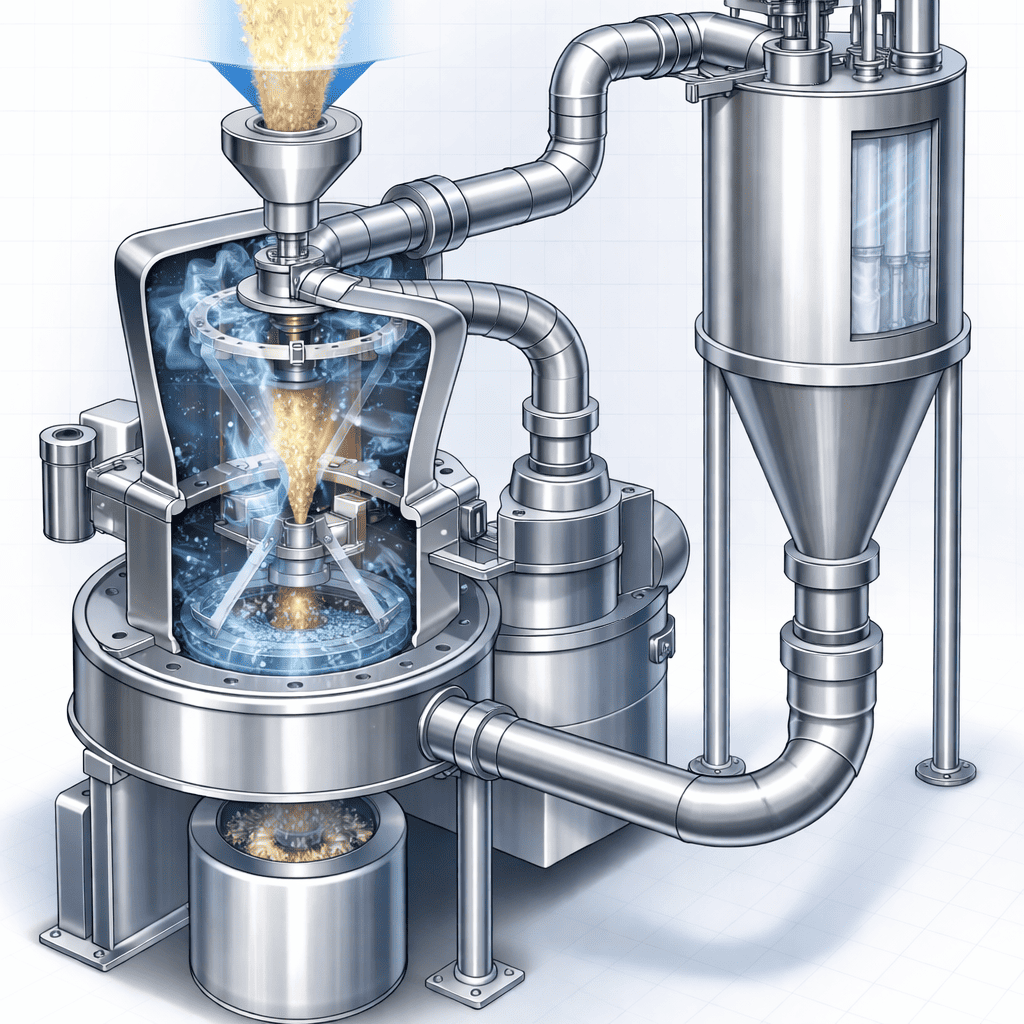
YDWF Series -- Closed-loop grinding and classification process
Process Flow
Technical Specifications
YDWF Series -- 8 standard models covering laboratory-scale to full industrial production. All specifications are reference values; actual performance depends on material properties.
| Model | Capacity (kg/h) | Feed Size (mm) | Output Fineness | Mill Motor (kW) | Classifier Motor (kW) | Overall Dimensions (mm) |
|---|---|---|---|---|---|---|
| YDWF-15 | 30-80 | ≤15 | 100-500 mesh | 11 | 1.5 | 3000×1600×2600 |
| YDWF-25 | 80-200 | ≤15 | 100-500 mesh | 15 | 2.2 | 3200×1700×2700 |
| YDWF-35 | 150-350 | ≤15 | 100-500 mesh | 18.5 | 3 | 3500×1800×2900 |
| YDWF-45 | 250-500 | ≤15 | 100-500 mesh | 22 | 4 | 3800×2000×3100 |
| YDWF-55 | 350-650 | ≤15 | 100-500 mesh | 30 | 5.5 | 4200×2200×3400 |
| YDWF-75 | 500-850 | ≤15 | 100-500 mesh | 37 | 7.5 | 4800×2600×3800 |
| YDWF-95 | 700-1050 | ≤15 | 100-500 mesh | 45 | 11 | 5200×2900×4000 |
| YDWF-120 | 900-1300 | ≤15 | 100-500 mesh | 55 | 20 | 5800×3200×4300 |
- Capacity
- 30-80 kg/h
- Feed Size
- ≤15 mm
- Fineness
- 100-500 mesh
- Mill Motor
- 11 kW
- Classifier
- 1.5 kW
- Capacity
- 80-200 kg/h
- Feed Size
- ≤15 mm
- Fineness
- 100-500 mesh
- Mill Motor
- 15 kW
- Classifier
- 2.2 kW
- Capacity
- 250-500 kg/h
- Feed Size
- ≤15 mm
- Fineness
- 100-500 mesh
- Mill Motor
- 22 kW
- Classifier
- 4 kW
- Capacity
- 900-1300 kg/h
- Feed Size
- ≤15 mm
- Fineness
- 100-500 mesh
- Mill Motor
- 55 kW
- Classifier
- 20 kW
Showing 4 of 8 models. Contact us for full specifications.
Important: Capacity figures are reference values based on medium-density, dry, non-fibrous materials. Actual throughput depends on material hardness, moisture content, oil content, target fineness, and feed consistency. Material testing is recommended before final model selection.
Application Industries
The YDWF Air Classifier Mill is deployed across a broad range of industries where fine particle size, consistent distribution, and clean processing are required.
Pharmaceutical
GMP / API Processing- Active Pharmaceutical Ingredients (APIs)
- Granulation and tableting pre-processing
- Excipient milling
- Herbal medicine fine powder
Chemical Industry
Pigments / Minerals / Specialty- Talc, carbon black, dry clay powder
- Coal powder, limestone, salt
- Dye and pigment powders
- Specialty fine chemical powders
Food Industry
Food-Grade / Hygienic Design- Ultrafine flour, rice, sugar powder
- Spice and seasoning fine powder
- Gluten and starch processing
- Food additive fine grinding
Nutraceuticals & Health
Supplements / Botanicals- Vitamin and mineral powders
- Botanical extract fine milling
- Protein powder processing
- Probiotic carrier powders
Pet Food & Animal Feed
Protein / Ingredient Processing- Bulk protein raw material fine milling
- Feed additive fine powder
- Premix ingredient processing
- Consistent particle size for palatability
Agriculture & Environmental
Fertilizer / Seed / Agrochem- Fertilizer fine grinding
- Seed coating material processing
- Agricultural chemical carrier powders
- Bio-material fine milling
How ACM Compares
Understanding which milling technology fits your material and production requirements is more important than selecting by machine type alone.
| Criterion | ACM (YDWF) | Jet Mill | Hammer Mill | Ball Mill |
|---|---|---|---|---|
| Finished Fineness | 100-500 mesh (40-100 µm) | 1-45 µm (ultrafine) | 20-200 mesh (coarser) | 1-100 µm (slow process) |
| Particle Size Control | Adjustable classifier wheel | Excellent, narrow PSD | Screen-dependent, less precise | Time-dependent, variable |
| Throughput Capacity | High (30-1300 kg/h) | Low to medium | High capacity | Low (batch process) |
| Temperature Rise | Moderate -- air cooling helps | Very low (gas expansion) | High -- not ideal for heat-sensitive | Low to moderate |
| Grinding Method | Mechanical impact + inter-particle friction | High-pressure gas jets + particle collision | Mechanical impact (hammer/screen) | Attrition and impact (media) |
| Wet Grinding | Dry only | Dry only | Wet or dry | Wet or dry |
| Equipment Cost | Medium-High | High (compressed air cost) | Lower cost | Medium (media wear cost) |
| Cleaning & Maintenance | Accessible, GMP design | Simple (no media) | Screen replacement required | Complex (media handling) |
| Best For | Fine powder, high volume, regulated industries | Ultrafine, low volume, heat-sensitive | Coarse to medium, high volume | Ultrafine, abrasive, batch |
Known Limitations
We believe in transparent communication. Understanding where the ACM is not the right choice is as important as knowing where it excels. Selecting the wrong equipment type leads to poor performance, high maintenance costs, and production downtime.
Fine Powder Only -- Not for Coarse Products
The ACM is designed for fine and ultrafine output (100-500 mesh). If your application requires coarse granules or particles above ~150 µm, a hammer mill or impact mill is a more appropriate and cost-effective choice.
Not Suitable for Sticky or Viscous Materials
Highly viscous materials such as putty, latex, wax-based compounds, or materials with very high oil or sugar content will adhere to grinding surfaces and classifier components, causing blockage and fouling. Testing is essential before confirming suitability.
Moderate Heat Generation
While air cooling reduces temperature rise compared to standard hammer mills, the grinding chamber does generate heat during operation. For extremely heat-sensitive materials (e.g., certain APIs with low melting points), a jet mill or cryogenic milling system may be required.
Higher Initial Investment
The ACM costs more than a standard hammer mill or pin mill of comparable capacity due to the integrated classifier mechanism, more complex drive system, and higher-precision manufacturing requirements. The investment is justified when fine particle size control and high yield are production priorities.
Dry Processing Only
The ACM is a dry milling system. It cannot process wet slurries or pastes. Materials with moisture content above approximately 5-8% may require pre-drying before processing, depending on the material's characteristics and target fineness.
Not sure if ACM is right for your material?
Before selecting a mill type, we recommend discussing your material properties with our engineering team. Key factors include moisture content, oil content, hardness, target fineness, and required capacity. Material testing is available.
Talk to an EngineerQuick Material Suitability Check
Purchasing Guide
Selecting an Air Classifier Mill is a significant capital investment. This guide outlines the key evaluation criteria to help you make an informed decision -- regardless of which supplier you choose.
Define Your Material & Process Requirements
Before contacting any supplier, document your material properties and production goals. This is the most important step.
- Material name, composition, moisture
- Feed size and target output fineness
- Required throughput (kg/h)
- Oil content, hardness, heat sensitivity
- Industry standard requirements (GMP, food-grade)
- Cleaning method and frequency
Evaluate Supplier Capability
Not all ACM manufacturers offer the same level of engineering support or quality consistency. Ask the right questions.
- Years of experience manufacturing ACM systems
- Can they test your actual material?
- Do they provide test reports and videos?
- SS304 or SS316L contact parts available?
- FAT support and documentation capability
- References from your industry
Confirm Technical Specifications Before Ordering
Verbal commitments are not enough. Ensure all technical parameters are documented and agreed upon before production begins.
- Model number and confirmed capacity
- Material of construction (SS grade, polishing)
- Motor power, voltage, frequency
- Dust collection configuration
- Control system (VFD, PLC, HMI)
- Overall dimensions and installation requirements
An ACM Manufacturer That Starts With Your Material
Yinda Machinery has been designing and manufacturing powder processing equipment since 2010. We don't recommend equipment by model number -- we evaluate your material, test it in our facility, and configure the system to match your actual production requirements.
Get a Quote or Request Material Testing
Tell us about your material and production goals. Our engineering team will review your requirements and recommend the appropriate YDWF model and system configuration.
Email Us
Send detailed material specs and receive a technical recommendation
Request Material Test
Ship your material to our facility for grinding, classification, and yield testing
Video Consultation
Schedule a video call with our engineering team to discuss your project