
Tray Dryer: Complete Product FAQ & Buyer's Guide
Everything you need to know about Yinda Machinery's YDHF series tray dryers -- from working principles and technical specs to applications, comparisons, and purchasing guidance.
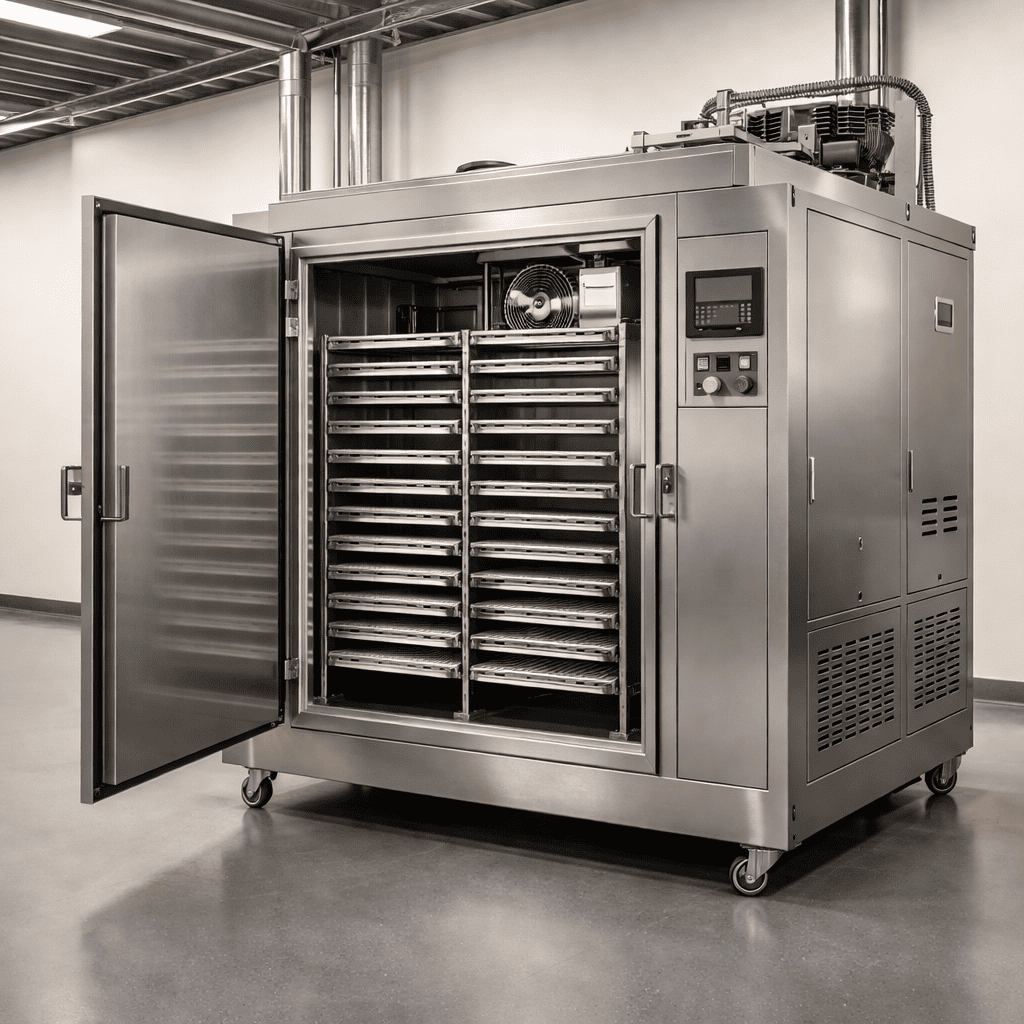
Product Overview
What is a Tray Dryer?
A tray dryer is a batch drying equipment that removes moisture from materials through convective heating inside an insulated chamber. Hot air circulates over material-loaded trays, evaporating moisture and carrying it away -- all within a sealed, cabinet-style enclosure.
Yinda Machinery's YDHF series tray dryers are designed for food, pharmaceutical, chemical, and agricultural applications where precise, gentle, and batch-controlled drying is required.
The core principle: a controlled heating program removes moisture from materials while maintaining product integrity and batch separation.
Compartmentalized Isolation
Each tray acts as an independent drying zone. Materials are fully separated -- no risk of cross-contamination or chemical reactions between batches.
Hygroscopic & Heat-Sensitive Materials
Especially suitable for materials that absorb moisture readily or are sensitive to high temperatures -- including pharmaceutical powders, herbs, and food ingredients.
Flexible Batch Control
Temperature, airflow, and drying time can be precisely set per batch -- ideal for R&D, small-to-medium production, and multi-product facilities.
Working Principle
The tray dryer operates on the principle of convective heat transfer. A blower fan circulates heated air through the insulated cabinet, passing over and through material-laden trays. The moving air absorbs moisture from the material surface and carries it out via the exhaust system.
The entire drying process is contained within a sealed cabinet, ensuring consistent temperature distribution and minimizing external contamination.
Step-by-Step Operation
- Inspect & Clean
Confirm the chamber is free of residual material and the main switch is in the OFF position.
- Load Material
Spread material evenly across individual trays. Do not mix different materials on the same tray.
- Seal the Cabinet
Close and latch the cabinet door securely using the clamping mechanism to ensure a proper seal.
- Set Parameters
Configure the target temperature and drying duration based on material properties and moisture requirements.
- Start & Monitor
Power on the unit, activate the blower and heater simultaneously, and allow the cycle to run to the preset time. Periodic checks are recommended for heat-sensitive materials.
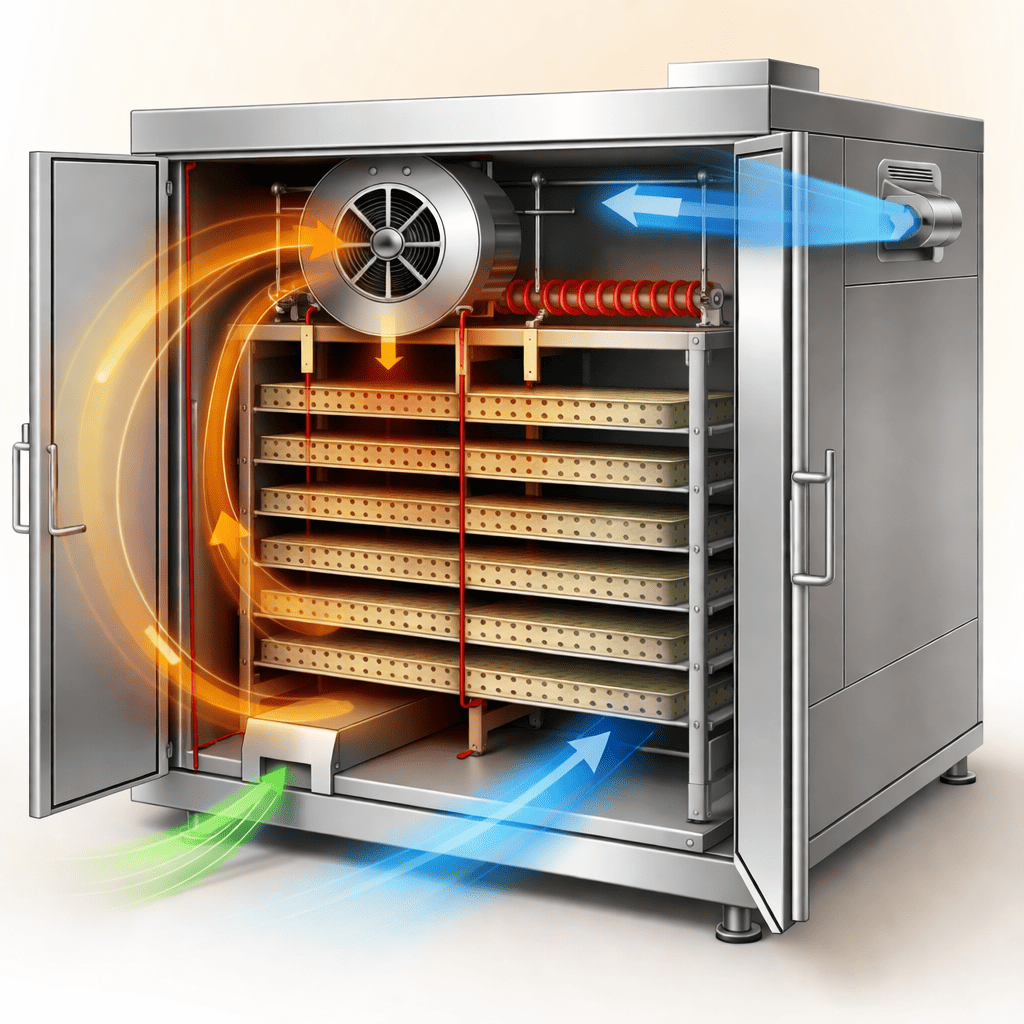
Key Process Parameters
Technical Specifications -- YDHF Series
Four standard models available. Custom configurations are possible based on your material, capacity, and process requirements.
| Parameter | YDHF-1 | YDHF-2 | YDHF-4 | YDHF-6 |
|---|---|---|---|---|
| Evaporation Area (m²) | 7.1 | 14.1 | 28.3 | 42.4 |
| Working Volume (m³) | 1.3 | 2.6 | 4.9 | 7.4 |
| Capacity (kg/batch) | 60 | 120 | 240 | 360 |
| Radiator Area (m²) | 15 | 23 | 48 | 72 |
| Electric Heating Power (kW) | 9 | 15 | 30 | 45 |
| Blower Power (kW) | 0.45 × 1 | 0.45 × 1 | 0.45 × 2 | 0.45 × 3 |
| Drying Racks (sets) | 1 | 2 | 4 | 6 |
| Trays (pcs) | 24 | 48 | 96 | 144 |
| Overall Dimensions (mm) | 1380×1200×2000 | 2360×1200×2000 | 2260×2200×2000 | 3240×2200×2000 |
| Weight (kg) | 800 | 1500 | 1800 | 2200 |
* Specifications subject to change. Custom configurations available. Contact our engineering team for project-specific requirements.
Types of Tray Dryers
Three primary configurations are available depending on production volume, material flow requirements, and operational preferences.
Batch / Cabinet Type
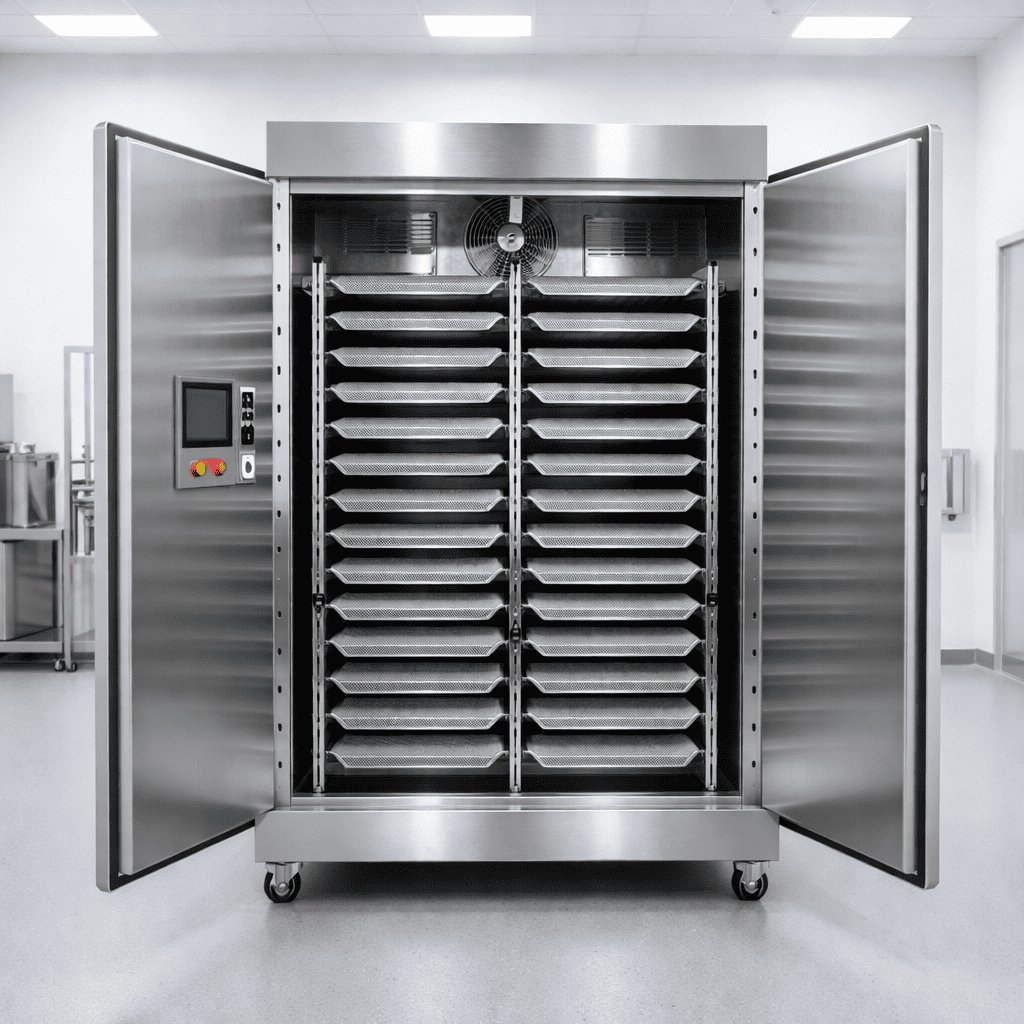
The traditional and most widely used configuration. Materials are loaded onto trays, the cabinet is sealed, and the entire batch is dried in a single cycle. Once complete, the operator unloads the batch before starting the next.
- ✓ Simple, proven design
- ✓ Full batch traceability
- ✓ Easy to clean between batches
- ✓ Ideal for multi-product facilities
Semi-Continuous Type
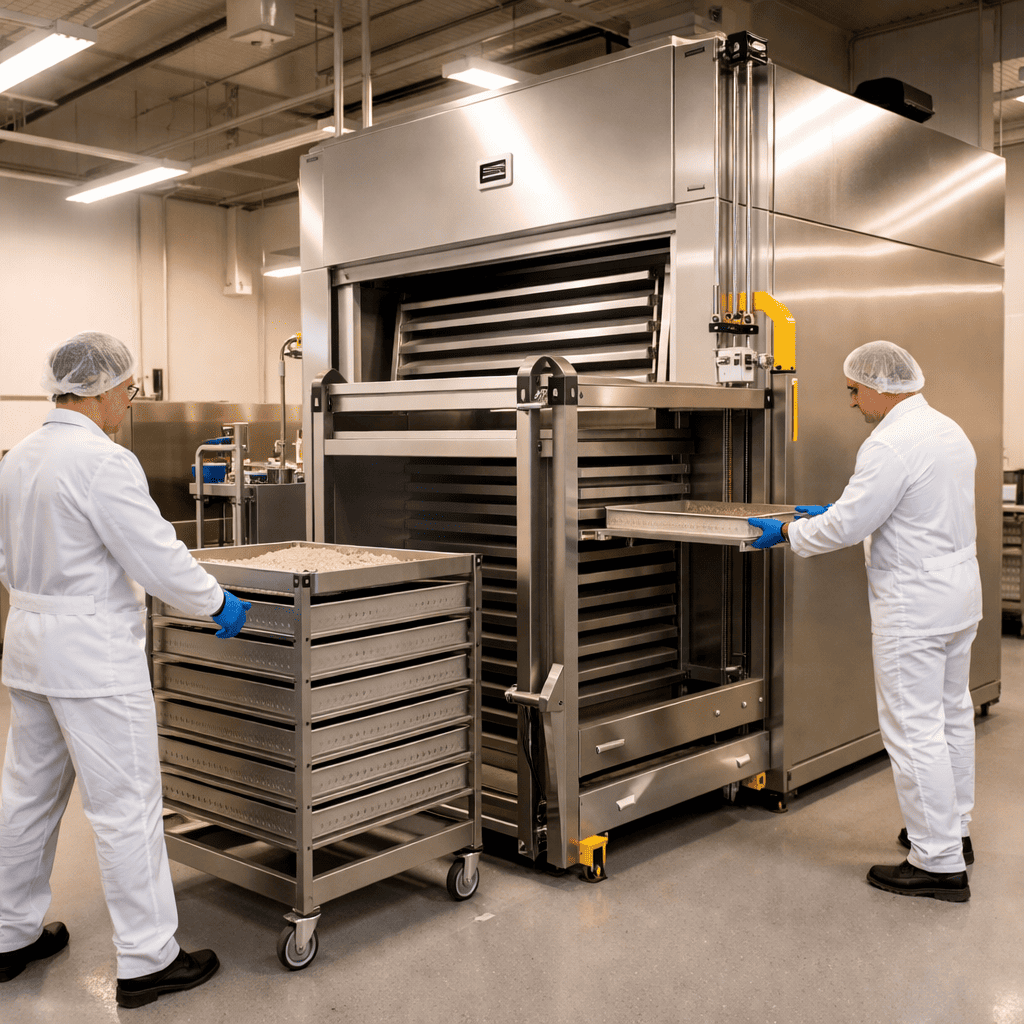
Equipped with a lifting mechanism that progressively moves trays upward. As the top tray completes drying, it is removed and a new loaded tray is inserted at the bottom -- enabling near-continuous operation without fully stopping the dryer.
- ✓ Higher throughput than batch type
- ✓ Reduced downtime between cycles
- ✓ Suitable for consistent single-product runs
- ✓ Compact footprint for output volume
Cross-Flow Type
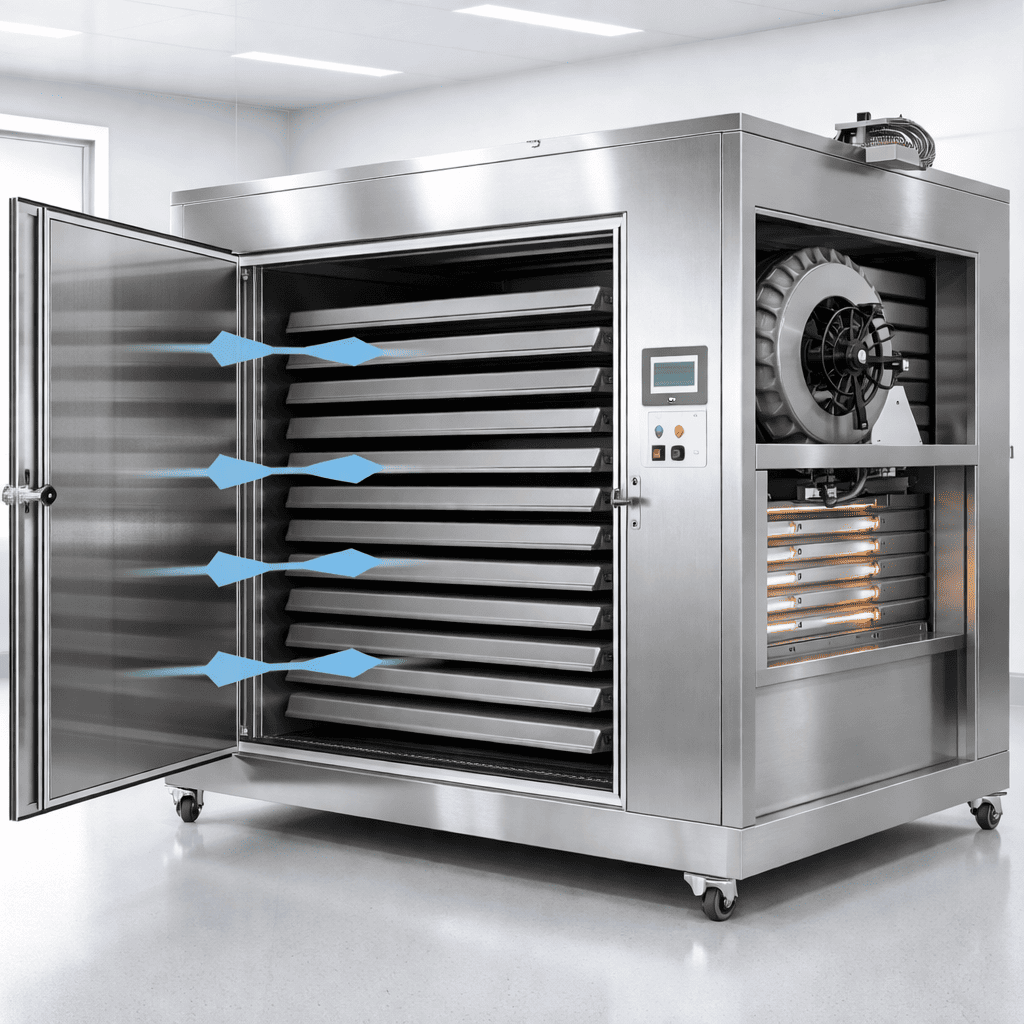
Air flows horizontally across the trays and is recirculated back to the heater, rather than being exhausted. This closed-loop design means virtually zero exhaust emissions -- making it well-suited for applications with strict environmental or odor control requirements.
- ✓ Near-zero exhaust emissions
- ✓ Higher energy efficiency
- ✓ Consistent airflow across all trays
- ✓ Suitable for odor-sensitive environments
Applications & Industries
Tray dryers are widely used across industries where batch drying, gentle heat treatment, and material isolation are priorities.
Food Industry
- Fruit & vegetable dehydration
- Spice & chili drying
- Grain & cereal drying
- Food ingredient processing
Pharmaceutical
- Active pharmaceutical ingredients
- Wet granule drying
- Chemical powder drying
- Herbal medicine processing
Chemical Industry
- Chemical intermediates
- Mineral drying
- Pigment processing
- Inorganic salts & compounds
Agricultural Products
- Herbs & plant materials
- Seeds & grains
- Agricultural by-products
- Feed additives
Common Material Examples
Advantages & Limitations
Advantages
Simple Operation
Load trays, seal the door, set temperature and time -- straightforward for operators at any skill level.
High Batch Capacity
Processes significantly more material per cycle compared to many other batch drying methods -- up to 360 kg/batch on YDHF-6.
No Cross-Contamination Risk
Each tray is fully isolated. Multiple materials can be dried simultaneously without chemical interaction between them.
Fuel / Energy Efficiency
Large batch volumes mean relatively low energy consumption per kilogram of dried material.
Minimal Labor During Drying
Once loaded and started, the dryer operates unattended -- freeing operators for other tasks during the cycle.
Compact Footprint
Cabinet design is easy to install, relocate, and integrate into existing production spaces without major facility modifications.
Reduced Waste & Better Yield
Precise temperature and time control reduces product degradation and minimizes material loss compared to uncontrolled drying methods.
Limitations & Considerations
Extended Drying Time
A single drying cycle may take several hours to nearly a full day depending on material moisture content, layer thickness, and target dryness. Not suitable for applications requiring rapid throughput.
Higher Capital Cost
Due to their robust construction, insulation, and control systems, tray dryers carry a higher upfront investment compared to basic drying alternatives. The value is realized over time through consistent output quality.
Risk of Over-Drying
Certain materials -- particularly hygroscopic or heat-sensitive ones -- may be over-dried if parameters are not set correctly. Periodic moisture checks during the cycle are recommended for critical applications.
Limited to Compatible Materials
Not all materials are suitable for tray drying. Certain plastics, highly flammable materials, or substances requiring inert atmosphere drying need alternative equipment or special configurations. Always confirm material compatibility before selecting this equipment.
Yinda's recommendation: For heat-sensitive, high-moisture, or novel materials, we strongly encourage sending a sample for a drying test before finalizing equipment selection. This eliminates uncertainty and confirms real-world performance.
Tray Dryer vs. Tunnel Dryer
Understanding the differences helps you select the right drying approach for your production scale, material type, and process requirements.
| Comparison Dimension | Yinda YDHF Series Tray Dryer | Tunnel Dryer |
|---|---|---|
| Material Movement | Static Material remains stationary on trays throughout the drying cycle | Continuous Movement Material travels through the tunnel, passing through different drying zones |
| Batch vs. Continuous | Batch operation -- full load per cycle | Continuous or semi-continuous operation |
| Material Isolation | Full Isolation Each tray is completely separated -- zero risk of chemical reactions between materials | Limited Isolation Zones are not fully insulated -- improper separation may lead to chemical interactions |
| Throughput | Moderate -- suitable for small to medium production volumes | High -- designed for large-scale continuous production |
| Footprint | Compact cabinet -- minimal floor space required | Large -- requires significant floor space and facility planning |
| Capital Investment | Lower initial investment | Higher capital cost |
| Cleaning & Changeover | Easy -- removable trays simplify cleaning and product changeover | More complex -- longer downtime for cleaning and product changes |
| Best Suited For | Multi-product, batch-controlled, hygroscopic & heat-sensitive materials | Single-product, high-volume, continuous industrial production |
Selection guidance: If your production requires handling multiple materials, strict batch control, easy cleaning between products, or involves hygroscopic/heat-sensitive materials -- a tray dryer is typically the more practical choice. For single-product, high-volume continuous operations, a tunnel dryer may offer better economics. Contact Yinda's engineering team to discuss your specific scenario.
Frequently Asked Questions
What materials are best suited for a tray dryer?
How long does a typical drying cycle take?
Can I dry multiple different materials simultaneously?
What material standards are used for food and pharmaceutical applications?
What is the correct model size for my production volume?
Can the tray dryer be integrated with upstream or downstream equipment?
What documentation is available for export and compliance purposes?
Purchasing Guide & Why Choose Yinda
A structured approach to selecting the right tray dryer -- and why Yinda Machinery is a trusted manufacturing and engineering partner.
Before You Buy: Key Questions to Confirm
Why Choose Yinda Machinery
Quality Certified
Products designed and manufactured to meet ISO, CE, and GMP international standards -- supporting your compliance requirements from the outset.
Competitive Pricing
Direct manufacturer pricing with no intermediary markup. Quotations are tailored to your actual project requirements -- no unnecessary upselling.
Engineering Expertise
A dedicated technical team evaluates your material and process requirements -- recommending the right configuration rather than simply listing available models.
Complete Processing Lines
Beyond tray dryers, Yinda manufactures crushers, mills, screeners, mixers, conveyors, and packaging line interfaces -- enabling single-source procurement for your entire processing line.
Pre-Shipment Testing
Every unit undergoes complete assembly inspection, functional testing, and calibration before shipment. FAT can be arranged per contract terms.
Global After-Sales Support
Remote technical consultation, installation guidance, operator training, spare parts supply, and troubleshooting support available to customers worldwide.
How to Get Started with Yinda
Submit Requirements
Share your material name, moisture content, batch size, and any compliance requirements.
Technical Assessment
Our engineering team evaluates your requirements and recommends the appropriate model and configuration.
Material Testing
Send a material sample for a drying test to confirm performance before ordering.
Confirm & Order
Review the technical specification, confirm configuration, and proceed with production.
Ready to Discuss Your Drying Requirements?
Share your material, batch size, and production goals with our engineering team. We'll recommend the right model, arrange a material test if needed, and provide a detailed quotation.
Yinda Machinery -- Professional Tray Dryer Manufacturer & Supplier from China
ISO / CE / GMP Compatible · Export Packaging & Documentation Available