
Ribbon Blender Machine
Industrial-grade horizontal ribbon blender for dry powder and granule mixing. Triple-action blending with inner and outer helical ribbons ensures fast, uniform results across food, pharmaceutical, chemical, and agricultural applications.

What Is a Ribbon Blender Machine?
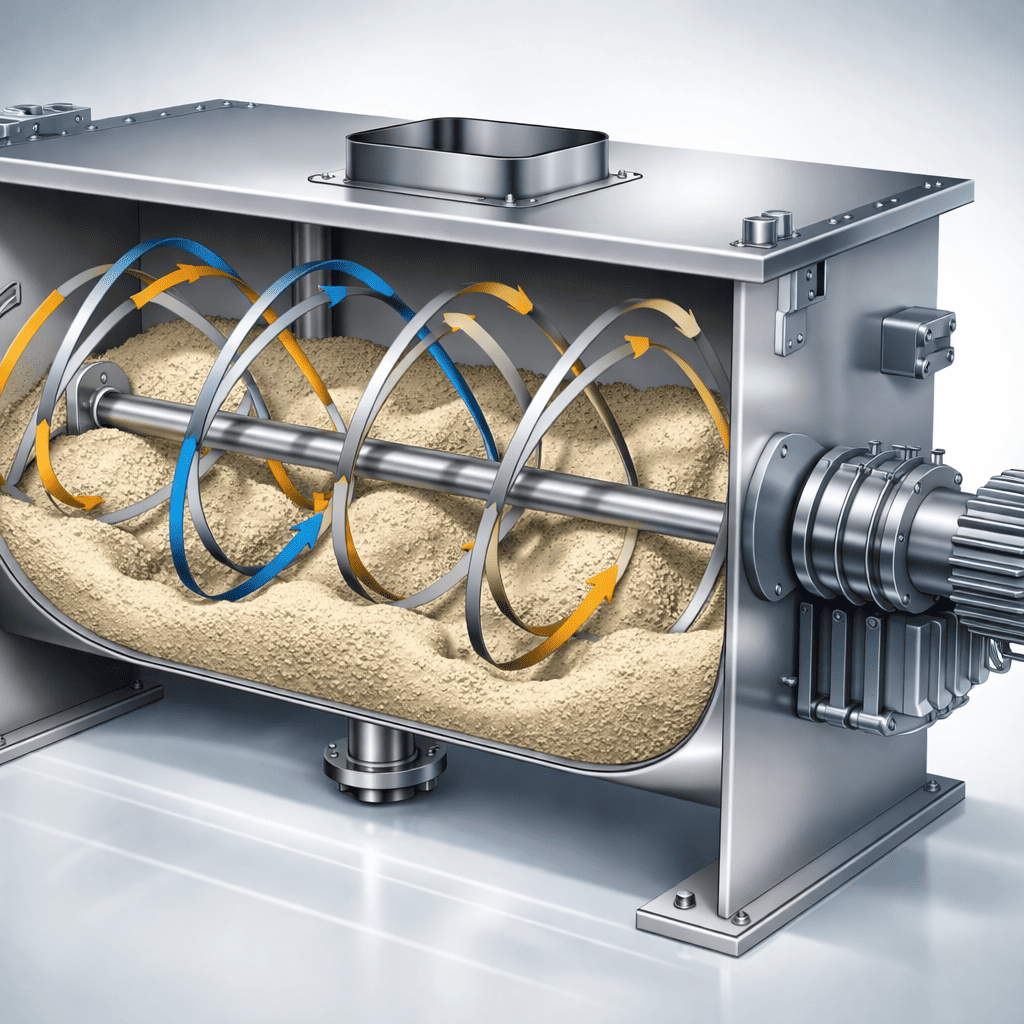
A ribbon blender is a high-efficiency mixing machine designed for dry powder and granule blending. Its core structure features a horizontal U-shaped trough containing a double helical ribbon agitator -- comprising inner and outer ribbon spirals -- that generates three simultaneous mixing actions for fast and thorough homogenization.
Yinda's YDLH series ribbon blenders are engineered to handle a wide range of materials, from free-flowing powders to cohesive granules, across food, pharmaceutical, chemical, and agricultural industries. All contact parts are available in SS304 or SS316L stainless steel with polished interior surfaces.
Technical Specifications
Standard models from 100L to 2000L total volume. Custom capacities available from 50L to 50,000L. Contact our engineering team for non-standard configurations.
| Parameter | YDLH-100 | YDLH-200 | YDLH-500 | YDLH-1000 | YDLH-1500 | YDLH-2000 |
|---|---|---|---|---|---|---|
| Total Volume (m³/L) | 0.1 / 100L | 0.2 / 200L | 0.5 / 500L | 1 / 1000L | 1.5 / 1500L | 2 / 2000L |
| Working Volume (L) | 60 | 120 | 300 | 800 | 1,200 | 1,600 |
| Mixing Speed (rpm) | 53 | 53 | 53 | 42 | 42 | 42 |
| Motor Power (kW) | 3 | 4 | 7.5 | 11 | 11 | 15 |
| Dimensions L×W×H (mm) | 1190×740×770 | 1550×1005×935 | 1972×1142×1300 | 2340×1437×1500 | 3180×1020×1550 | 3310×1120×1640 |
| Weight (kg) | 330 | 720 | 980 | 1,700 | 1,800 | 2,100 |
* Highlighted column (YDLH-500) is the most commonly selected model for mid-scale production. Custom models from 50L to 50,000L available on request. Specifications subject to change without notice.
Contact Material
SS304 standard; SS316L available for pharmaceutical and food-grade applications. Interior surfaces mirror-polished on request.
Drive Options
Standard motor, variable frequency drive (VFD), explosion-proof motor, or speed-adjustable motor. Custom voltage and frequency available.
Discharge Options
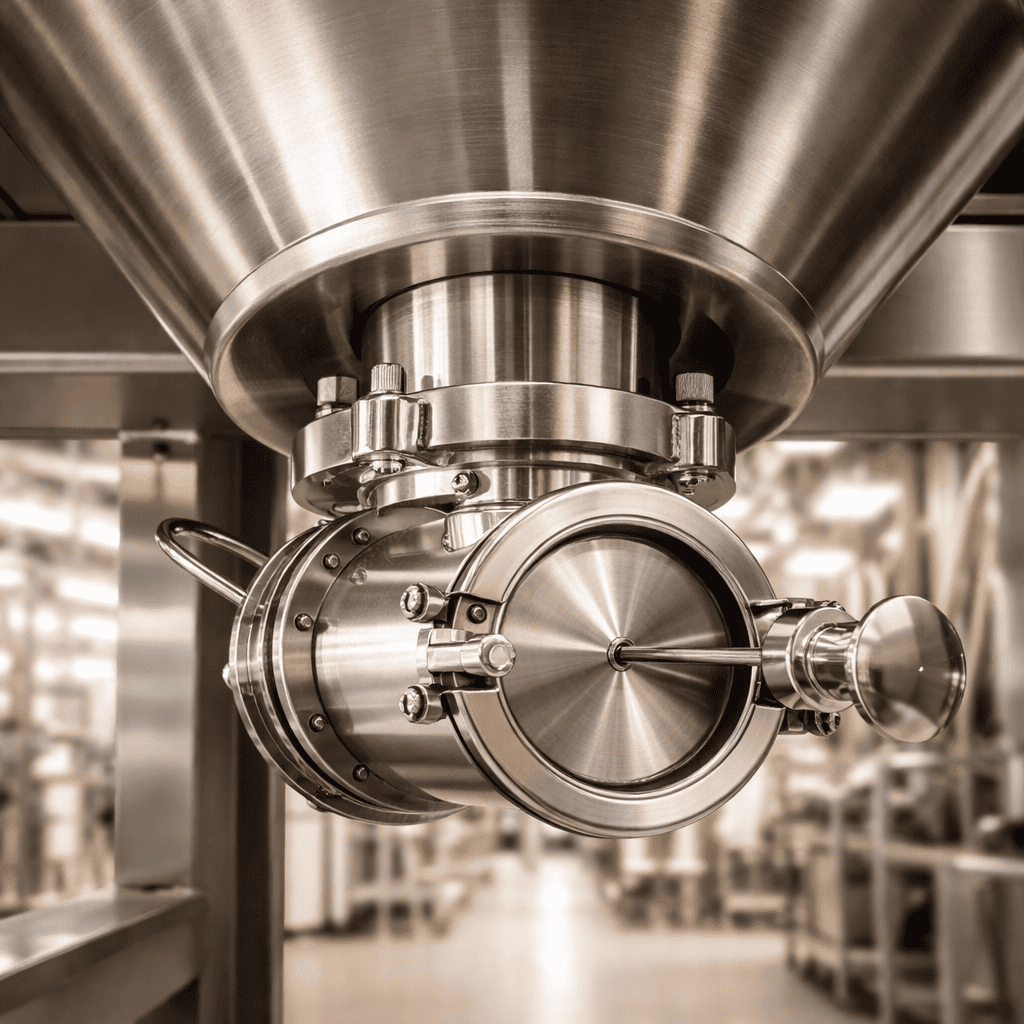
Round valve, knife gate valve, rotary ball valve, or butterfly valve. Manual, electric, or pneumatic actuation available.
Key Components & Functions
Each component of the ribbon blender is engineered to work in concert, ensuring stable mixing performance, easy cleaning, and long service life.
Mixing Vessel
U-shaped cylindrical trough where all blending takes place. Available in SS304 or SS316L with smooth, cleanable interior surfaces. Designed to minimize dead zones and material retention.
Top Flat Cover
Tight-fitting stainless steel lid that seals the trough during operation. Designed for quick removal to facilitate loading, inspection, and cleaning. Inspection windows available on request.
Discharge Assembly
Multiple valve options: round valve, knife gate valve, rotary ball valve, or butterfly valve. Supports mechanical, electric, or pneumatic control. Low residue design for efficient discharge.
Rotating Shaft
Horizontal central shaft spanning the full trough length. Drives the ribbon agitator at high speed (80-100 m/min peripheral velocity). Precision-balanced to minimize vibration and extend bearing life.
Agitator Element
Inner and outer helical ribbon spirals wound in opposite directions. The outer ribbon moves material inward; the inner ribbon moves it outward -- creating counter-flow that ensures thorough blending of both solids and liquids.
Control System
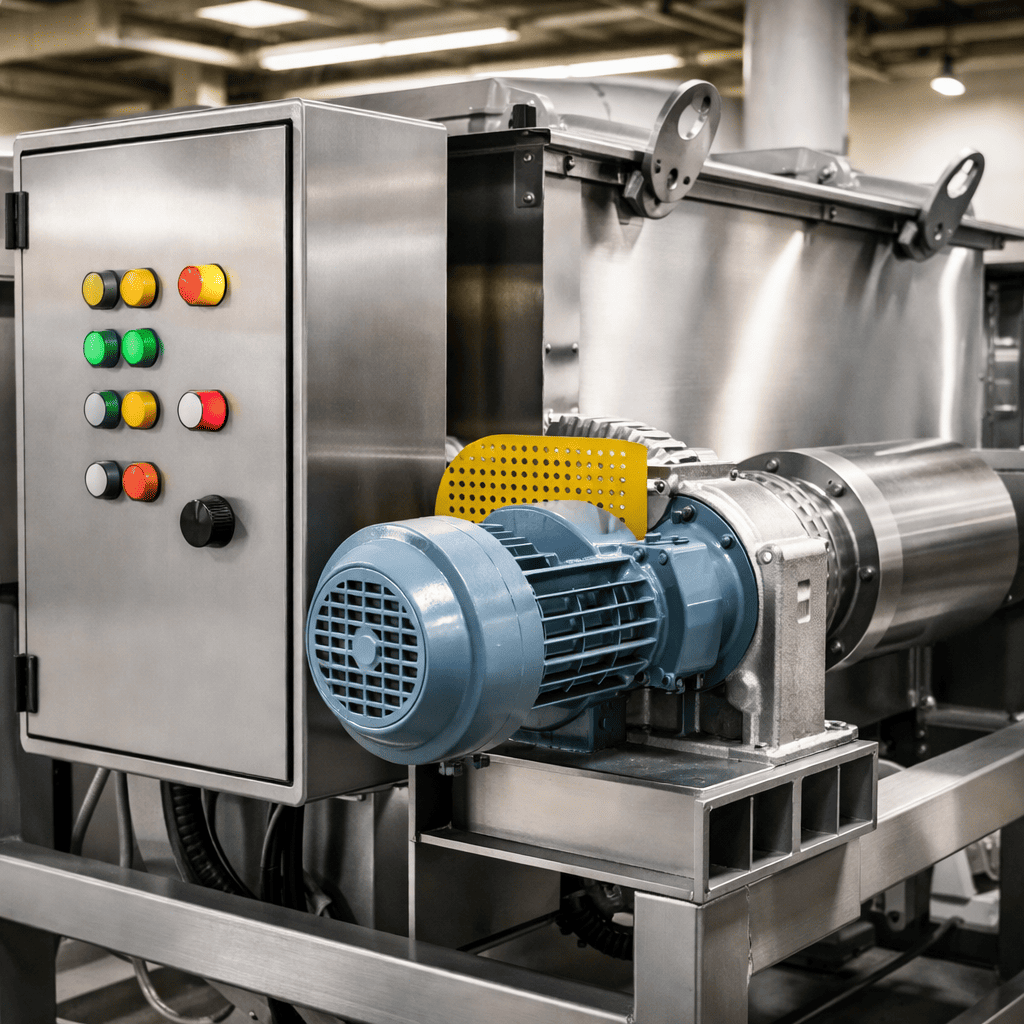
Main power controller, safety limit switches, fuse protection, and emergency stop. Optional: PLC with touchscreen, timer control, temperature monitoring, VFD speed adjustment, and safety interlocks.
Drive Mechanism
Motor and gearbox assembly with single-side mounting for easy maintenance access. Options include standard motor, VFD-controlled motor, explosion-proof motor, or speed-adjustable motor to suit different materials and process requirements.
Working Principle
The ribbon blender achieves uniform mixing through two fundamental mechanisms that work simultaneously to move material at both macro and micro levels.
Convective Blending
Large groups of particles are transported across the horizontal plane of the mixing vessel by the ribbon agitator system. The outer ribbon moves bulk material from the ends toward the center, while the inner ribbon simultaneously moves material from the center toward the ends -- creating continuous, large-scale circulation throughout the entire batch.
Diffusion Blending
Individual particles are displaced relative to their neighboring particles through the turbulent motion created by the counter-rotating ribbon action. This micro-level mixing ensures that even minor components are uniformly distributed throughout the batch -- critical for accurate dosing in pharmaceutical and food formulations.
Optimal Loading Guidelines
Rule of Thumb: Load at 50% of total vessel volume for optimal mixing efficiency. Overfilling reduces the free space needed for material circulation; underfilling reduces mixing contact and may affect batch uniformity.
Ribbon Flow Direction
Application Industries
The ribbon blender is one of the most versatile and cost-effective solid mixing machines available. It handles a broad range of materials across multiple industries.
Food Industry
- Baby food & infant formula
- Spices & seasonings
- Breakfast cereals
- Cake premix & baking blends
- Nutritional supplements
- Instant beverage powders
Pharmaceutical
- Pharmaceutical powders
- Polymer blends
- Compound filling
- Tablet pre-blends
- Herbal medicine powders
- Nutraceuticals
Agriculture & Pet Food
- Animal feed & additives
- Pet food formulations
- Bird seed blends
- Fertilizer blends
- Pesticide powders
- Herbicide formulations
Chemical & Industrial
- Dyes & pigments
- Detergents & cleaners
- Gypsum & abrasives
- Powder plastics
- Dry mortar blends
- Cosmetic ingredients
Key Advantages
Long Service Life
Robust stainless steel construction with precision-machined components ensures service life exceeding 20 years under normal operating conditions.
High Mixing Efficiency
Dual helical ribbons rotating at high speed combined with triple mixing action deliver uniform blending results in shorter cycle times compared to tumble blenders.
Excellent Sealing
Tight sealing design prevents material leakage during operation, reducing product loss, dust exposure, and cross-contamination risk.
Easy Maintenance
Single-side drive mounting provides unobstructed access to the interior for cleaning, inspection, and part replacement. Minimal dead zones simplify washdown.
Repeatable Control
Timer-based control enables consistent batch-to-batch results. Optional PLC with touchscreen allows recipe storage, parameter logging, and automated operation.
Versatile Discharge
Multiple discharge valve options with direct, gravity-fed outlet design ensure fast, complete emptying. Compatible with downstream packaging, conveying, and filling equipment.
Ribbon Blender vs. Other Mixers
Understanding the differences between mixer types helps you select the right equipment for your specific material and production requirements.
| Feature | Ribbon Blender | Paddle Mixer | IBC Bin Blender | Double Cone |
|---|---|---|---|---|
| Mixing Action | Triple (convection + diffusion + shear) | Lateral force / low viscosity | 360° symmetrical tumble | Gentle tumble |
| Mixing Time | Short | Medium | Medium-Long | Medium-Long |
| Vessel Shape | U-shaped trough | U-shaped trough | IBC bin / cube | Double cone |
| Number of Ingredients | 2-10 components | 2-5 components | 2-5 components | 2-5 components |
| Footprint / Height | Horizontal / moderate height | Horizontal / low height | Vertical / tall | Vertical / less headroom |
| Batch Transfer | Direct discharge valve | Direct discharge | Minimal transfer (IBC) | Bottom discharge |
| Ideal For | Dry powder, granules, multi-ingredient | Low-viscosity fluids | Pharma, multi-product | Fragile granules, gentle mix |
Horizontal Ribbon Blender
Recommended- Higher blending uniformity
- Shorter mixing cycle time
- Suitable for larger batch volumes
- Supports liquid spray addition
- Standard for industrial production
Vertical Ribbon Blender
Small Scale- Compact footprint for small spaces
- Suitable for small-scale operations
- Material lifted vertically then falls back
- Lower uniformity vs. horizontal
- Not ideal for large batch production
Maintenance Guide
Regular preventive maintenance is essential to ensure consistent performance, extend equipment life, and avoid unplanned downtime. Follow these key maintenance checkpoints:
Bearing Lubrication
Gearbox Oil Level
Drive Belt & Alignment
Discharge Valve & Seals
Ribbon Agitator Cleaning
Warranty Coverage
1 to 5 years depending on configuration
Structural components and welded assemblies
Drive mechanism and gearbox
Electrical components and control system
Wear parts (seals, belts, bearings) subject to normal wear exclusions
Warranty terms, start date, coverage scope, and spare parts responsibilities must be confirmed in writing before order placement. Contact our sales team for project-specific warranty documentation.
Quality Certifications
Ribbon Blender FAQ
Comprehensive answers to the most common questions about ribbon blender selection, operation, and purchasing.
Working Principle
How does a ribbon blender achieve uniform mixing?
What is the recommended fill level for a ribbon blender?
Can a ribbon blender handle liquid additions during mixing?
Technical Specifications
What capacity range is available for YDLH series ribbon blenders?
What is the ribbon peripheral speed and why does it matter?
What material options are available for food and pharmaceutical applications?
Applications & Selection
Is a ribbon blender suitable for sticky or hygroscopic materials?
How many ingredients can a ribbon blender mix simultaneously?
When should I choose a ribbon blender over a V-blender or double cone?
Purchasing Guide
What information should I provide when requesting a ribbon blender quote?
Can I test my material before purchasing?
What customization options are available?
Does Yinda provide installation support and operator training?
What spare parts should I stock for a ribbon blender?
Ready to Select Your Ribbon Blender?
Yinda Machinery is a professional ribbon blender manufacturer in China, compliant with ISO/CE/GMP standards. We offer competitive pricing, comprehensive technical support, and fast delivery. Our engineers will help you select the right model based on your material, batch size, and production requirements.