
Freeze Dried Chicken Bone Powder Machine: Fine Grinding Solution (150-200 Mesh)

YINDA Powder Processing Solution
Freeze Dried Chicken Bone Powder Machine: Fine Grinding Solution (150-200 Mesh)
For producing fine freeze dried chicken bone powder from de-oiled, freeze-dried chicken breast bone, the Yinda YDWF Series Air Classifier Mill (ACM Mill) is a suitable single-stage fine grinding solution.
Quick Answer: What Machine Is Suitable for Grinding Freeze Dried Chicken Bone Powder?
Because the freeze-dried material is already relatively small and brittle after drying and de-oiling, it can be fed directly into the ACM Mill without a separate coarse-crushing stage in most cases.
The recommended process is:
Freeze Dried Chicken Breast Bone (De-oiled) -> YDWF Series ACM Mill -> Cyclone Separation -> Pulse Dust Collection -> Fine Chicken Bone Powder (150-200 Mesh)
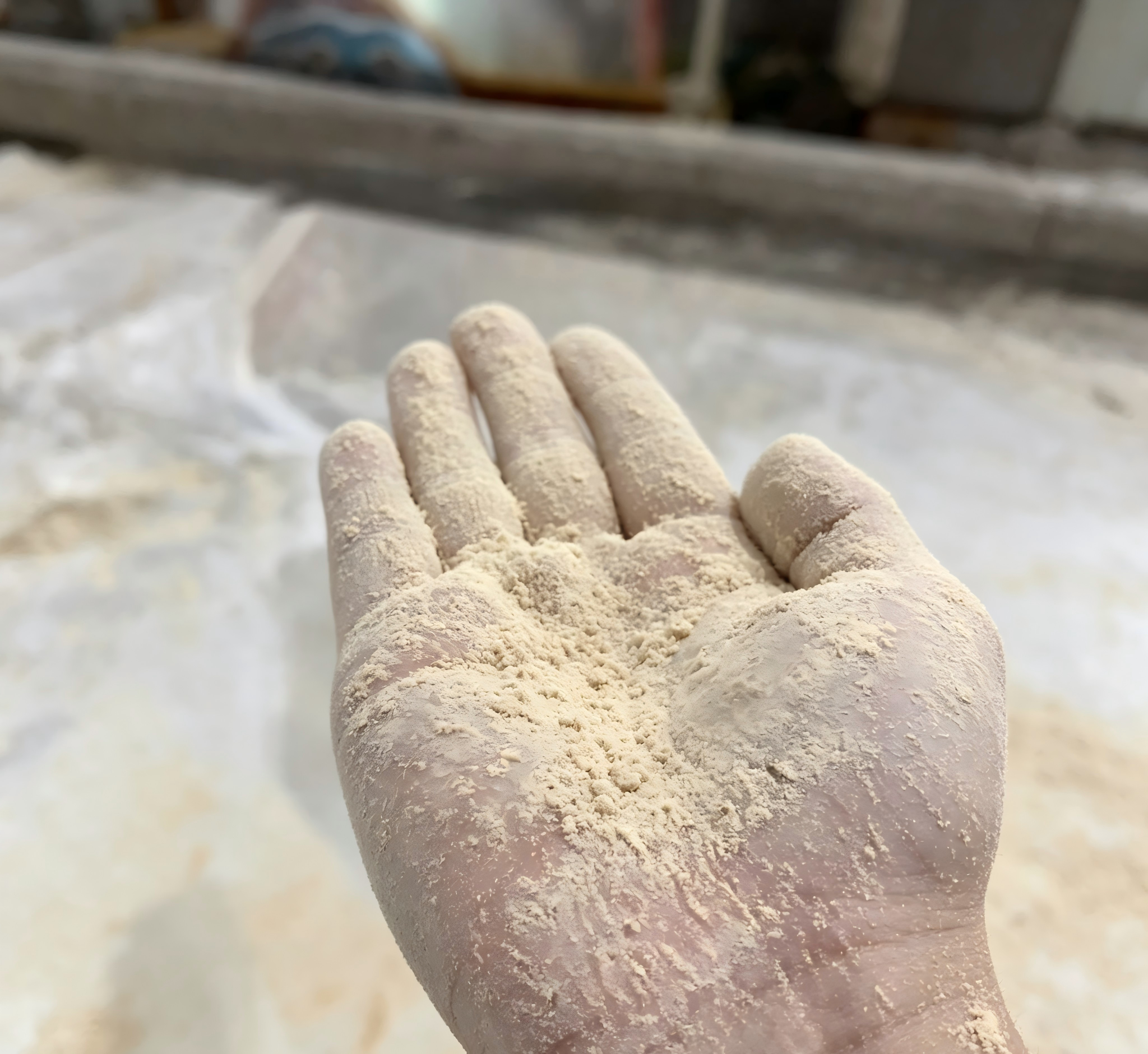
In Yinda actual grinding test and according to customer requirements, the YDWF ACM Mill can produce freeze dried chicken bone powder with a fineness of approximately 150 to 200 mesh.
Because chicken bone contains residual fat and protein, the powder may become slightly sticky during high-speed grinding. The YDWF ACM Mill uses air classification instead of screens or sieves, so there is no screen blockage even with slightly tacky material. When temperature control is important for protecting protein quality and reducing fat oxidation, a YDLF series air-cooled chiller can be added.
Confirmed values:
閳?/span> Fine grinding (YDWF ACM): approximately 150-200 mesh freeze dried chicken bone powder
閳?/span> Single-stage process: direct feeding into the ACM Mill (material already small and brittle)
閳?/span> Screen-less design: no blockage from slightly sticky, fatty bone powder
閳?/span> Optional air cooling: YDLF chiller for temperature-sensitive protein/fat protection
The actual production capacity should be confirmed through material testing according to the raw material condition and target fineness.

Introduction
Freeze dried chicken bone powder is a high-protein, high-calcium ingredient increasingly used in pet food, nutritional supplements and functional food products. Freeze drying locks in nutrients and makes the bone brittle, while de-oiling reduces fat content and improves storage stability.
However, turning freeze-dried chicken breast bone into a fine, uniform powder requires a suitable grinding machine. The material contains bone minerals, protein and residual fat, which may cause sticking, heat build-up and inconsistent particle size during grinding. A screen- or sieve-type mill may suffer from blockage, especially when the powder becomes slightly tacky.
The Yinda YDWF Air Classifier Mill (ACM Mill) is designed for this type of fine powder production. With air classification instead of screens, precise particle-size control and optional air cooling, it provides a stable solution for freeze dried chicken bone powder at around 150-200 mesh.
Material Characteristics and Challenges of Freeze Dried Chicken Bone
Freeze dried chicken breast bone is different from ordinary grain or spice materials. Its grinding performance is affected by several characteristics, and each one has a matching solution in the Yinda freeze dried chicken bone powder machine.

1. Brittle After Freeze Drying – Suitable for Direct Fine Grinding
Freeze drying removes moisture at low temperature and makes the bone structure brittle. De-oiled, freeze-dried chicken breast bone is therefore relatively easy to reduce into fine powder, and because the pieces are already small, it can usually be fed directly into the YDWF ACM Mill without a pre-crushing stage.
This simplifies the process and reduces equipment investment compared with hard, large-size raw materials that require two-stage grinding.
2. Residual Fat May Cause Sticking During Grinding
Although the material is de-oiled, a certain amount of residual fat remains in chicken bone. During high-speed fine grinding, friction heat can soften this residual fat, making the powder slightly sticky and prone to adhering to machine surfaces.
In traditional screen- or sieve-type mills, this often leads to screen blockage and unstable output.
Solution: The YDWF ACM Mill uses air classification instead of screens or sieves. There is no screen to block, so the mill can process slightly sticky chicken bone powder with stable, continuous output and uniform fineness.
3. Protein and Fat Are Heat-Sensitive
Chicken bone powder contains protein and fat, both of which are sensitive to heat. Excessive grinding temperature may cause protein denaturation, fat oxidation, off-flavours and reduced powder quality – especially important for pet food and nutritional applications where nutrient retention matters.
Solution: The YDWF ACM Mill works with airflow that helps carry heat away from the grinding zone, and a YDLF series air-cooled chiller can be integrated when stricter temperature control is required, reducing heat accumulation and protecting protein and fat quality during continuous production.
4. Bone Mineral Hardness and Wear
Bone contains mineral components (mainly calcium phosphate / hydroxyapatite) that are harder than pure meat or plant materials. Fine grinding to 150-200 mesh places demands on the grinding components and classification accuracy.
Solution: The YDWF ACM Mill uses high-speed grinding components combined with a dynamic classifier wheel. Oversized hard particles are automatically returned to the grinding zone for further reduction, while only qualified fine powder passes through to collection – ensuring consistent 150-200 mesh output.
5. Final Application Determines Fineness
The required particle size depends on how the chicken bone powder will be used:
閳?/span> pet food and pet supplement formulations;
閳?/span> calcium-fortified food and beverage ingredients;
閳?/span> bone broth powder and seasoning blends;
閳?/span> nutritional powder and functional food applications.
A fineness of 150-200 mesh is commonly required for fine, easy-to-mix chicken bone powder, which the YDWF ACM Mill is designed to achieve.
Recommended Freeze Dried Chicken Bone Powder Process Flow
Raw Material Inspection
->
Freeze Drying and De-oiling (upstream pretreatment)
->
YDWF Series ACM Mill (Direct Fine Grinding)
->
Cyclone Separation
->
Pulse Dust Collection
->
Fine Chicken Bone Powder Collection (150-200 Mesh)

Optional equipment may include:
閳?/span> feeding hopper;
閳?/span> screw or vacuum conveying system;
閳?/span> magnetic separator (for bone fragment metal detection);
閳?/span> cyclone separator;
閳?/span> pulse dust collector;
閳?/span> rotary airlock;
閳?/span> YDLF air-cooled chiller;
閳?/span> vibrating sifter (for final quality check);
閳?/span> powder collection bin;
閳?/span> packing machine.
If the incoming freeze-dried pieces are unusually large or irregular, a YDCS coarse crusher can be added before the ACM Mill. For typical small, brittle de-oiled freeze-dried chicken breast bone, the single-stage ACM Mill process is sufficient. The complete configuration should be selected according to production capacity, plant layout, cleanliness requirement and final powder specification.
Machine Selection: YDWF Series Air Classifier Mill (ACM Mill)
The Yinda YDWF ACM Mill is an integrated grinding and classification system designed for producing fine and uniform powder without traditional screens or sieves. It combines grinding, air classification and powder separation in one complete system, making it well suited as a freeze dried chicken bone powder machine.

Why Choose the YDWF ACM Mill for Freeze Dried Chicken Bone Powder?
1. Fine Grinding to 150-200 Mesh Without Screens
Unlike traditional grinding equipment that relies on screens for particle-size control, the YDWF ACM Mill uses an air classification system. This avoids screen blockage from slightly sticky, fatty chicken bone powder and provides more stable continuous operation with a more uniform particle-size distribution.
2. Integrated Grinding and Classification
The built-in dynamic classifier continuously separates oversized particles and returns them to the grinding chamber, allowing only qualified 150-200 mesh powder to leave the system. This helps achieve stable powder fineness, improved grinding efficiency and reduced over-grinding.
3. Suitable for Heat-Sensitive Protein and Fat Materials
The ACM Mill adopts airflow classification technology, which helps control the grinding environment. With an optional YDLF air-cooled chiller, it is suitable for processing heat-sensitive materials such as protein- and fat-containing chicken bone powder, helping protect nutrient quality during continuous fine grinding.
4. Wide Application Range
The YDWF ACM Mill is widely used for fine powder processing in industries including food, pet food, pharmaceutical, chemical and nutraceuticals. It can process various dry materials such as freeze dried chicken bone, herbs, grain products, plant-based powders and other dry materials.
YDWF ACM Mill Performance Features
According to different production requirements, the YDWF series provides multiple models with different capacity ranges. Key features include:
閳?/span> Fine grinding and classification in one system
閳?/span> Screen-less powder processing – no blockage from sticky material
閳?/span> Uniform particle-size distribution (150-200 mesh achievable)
閳?/span> Easy disassembly and cleaning
閳?/span> Suitable for continuous production
閳?/span> Efficient dust collection system for cleaner operation
閳?/span> Optional YDLF air-cooled chiller for temperature control
Working Principle
How Does the YDWF ACM Mill Work?
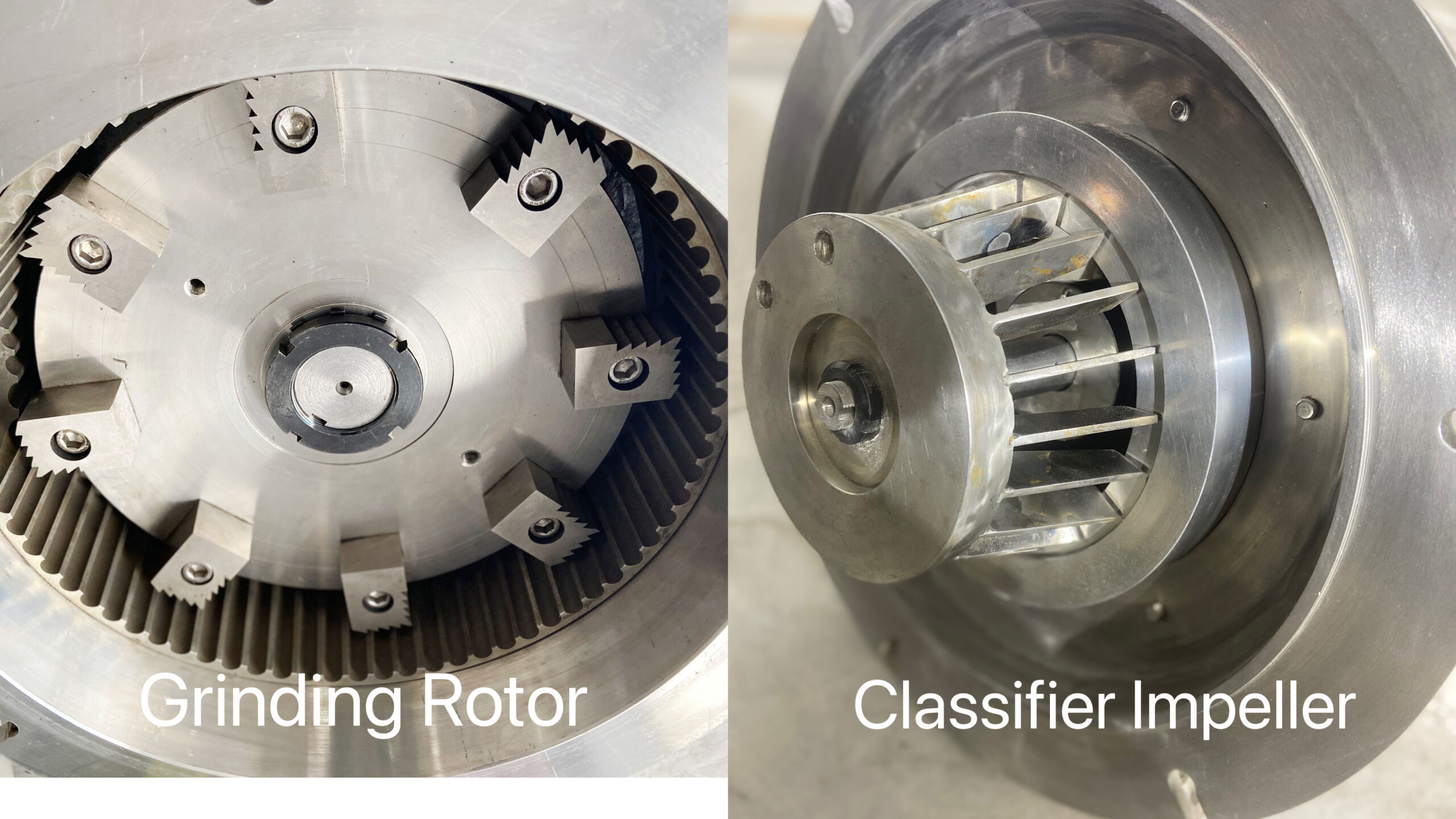
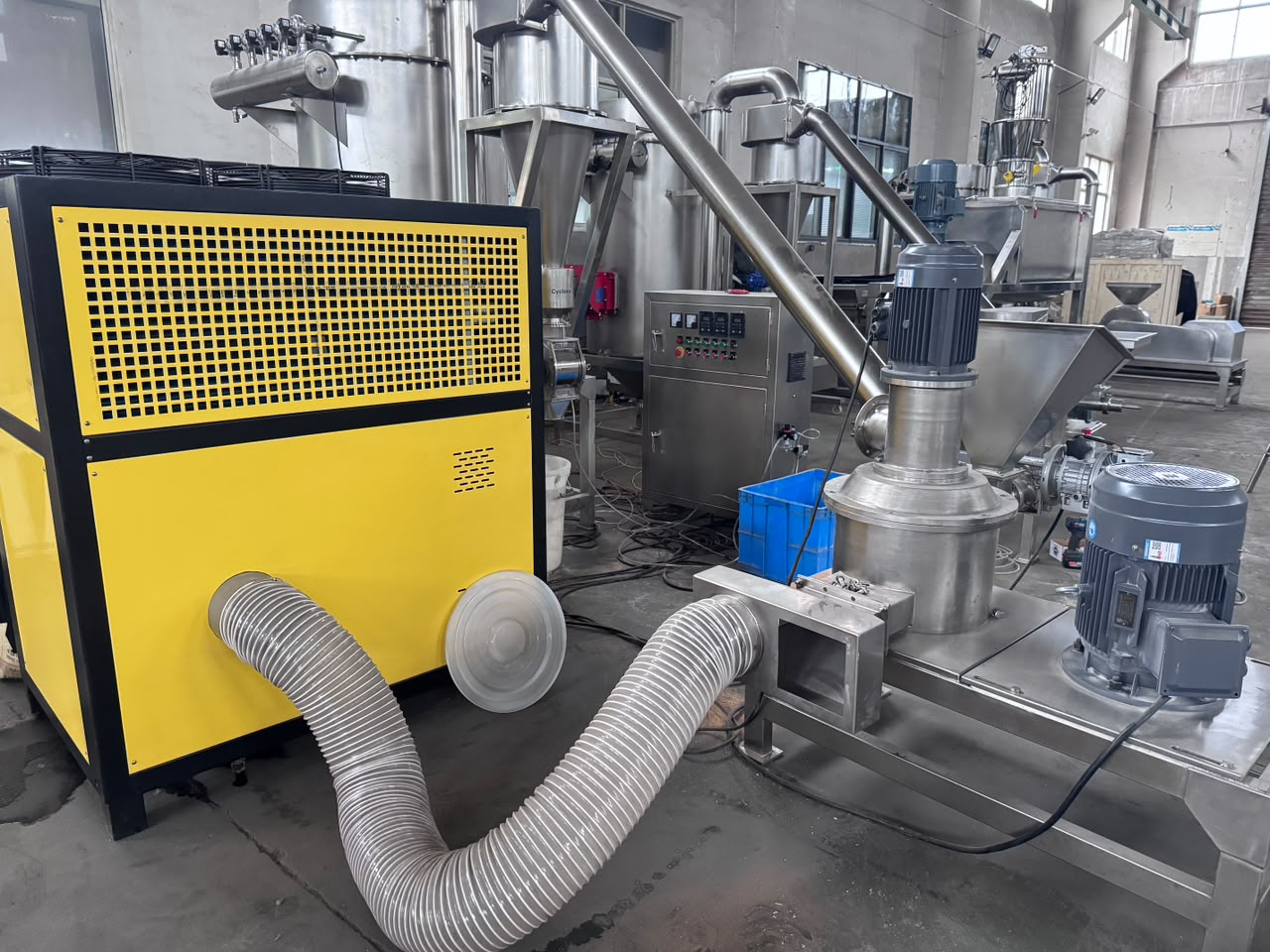
A complete ACM grinding system typically includes a feeding device, ACM grinding chamber, dynamic classifier, cyclone separator, pulse dust collector, induced-draft fan, rotary airlock, control cabinet and powder collection container.
The freeze-dried chicken bone material enters the grinding chamber through the feeding system and is reduced by high-speed rotating grinding components. The airflow then carries the ground powder into the classification chamber.
The classifier wheel separates particles according to size:
閳?/span> particles larger than the required size are returned to the grinding chamber for further grinding;
閳?/span> fine particles that meet the required fineness (150-200 mesh) are transported to the cyclone separator and dust collector for collection.
Through the combination of grinding force, airflow and classification technology, the ACM Mill achieves precise particle-size control and uniform powder output. Because classification is done by airflow rather than a screen, slightly sticky chicken bone powder does not block the system, allowing stable and continuous production.
The cyclone collects most of the powder carried by the airflow. The pulse dust collector captures finer particles that are not separated by the cyclone. The required filter area and airflow should be calculated according to the system design rather than selected only according to the target mesh.
Configuration Options
Option 1: ACM Mill with Complete Cyclone and Pulse Dust Collection
When workshop cleanliness and powder recovery are important, the ACM Mill can be supplied with a complete cyclone separator and pulse dust collector. This configuration captures both coarse and fine fractions, reduces airborne dust and improves powder yield. It is more suitable for food and pet food workshops, continuous production and enclosed production areas.
Option 2: YDWF ACM Mill with YDLF Air-Cooled Chiller
Fine grinding generates heat due to high-speed impact, airflow friction and continuous material circulation. For freeze dried chicken bone powder – which contains heat-sensitive protein and residual fat – a YDLF series air-cooled chiller can be integrated into the system for better temperature management.
Cooling may help reduce the risk of:
閳?/span> excessive heat accumulation;
閳?/span> protein denaturation and nutrient loss;
閳?/span> fat oxidation and off-flavours;
閳?/span> powder sticking caused by softened fat;
閳?/span> reduced flowability;
閳?/span> unstable powder collection.
However, the chiller should not be described as guaranteeing a fixed discharge temperature. The actual powder temperature depends on ambient temperature, material inlet temperature, feeding rate, grinding time, target fineness, equipment model, system airflow and chiller capacity. A required discharge temperature should be treated as a test condition rather than a standard machine specification.
Option 3: SS304 or SS316L Product-Contact Parts
For general food and pet food powder processing, SS304 is commonly considered for product-contact parts. SS316L may be requested when stronger corrosion resistance is required, when the customer has a specific internal material standard, or for pharmaceutical and special food applications. The stainless-steel scope (grinding chamber, feeding hopper, cyclone, powder pipes, collection bin, etc.) should be defined clearly.
Comparison Analysis
Single-Stage ACM Grinding vs. Two-Stage Crushing + Grinding
For small, brittle, de-oiled freeze-dried chicken breast bone, a single-stage YDWF ACM Mill is generally sufficient and more cost-effective. A two-stage process (coarse crusher + ACM Mill) is only needed when the incoming pieces are unusually large or hard. The final decision should depend on feeding size, target fineness, capacity and test results.
Screen-Type Mill vs. Screen-less ACM Mill
Traditional screen or sieve mills often suffer from blockage when grinding fatty, slightly sticky chicken bone powder. The screen-less ACM Mill avoids this problem and provides more uniform particle size and more stable continuous output at 150-200 mesh.
ACM Mill Without Chiller vs. ACM Mill with Chiller
The YDLF chiller is an optional temperature-control configuration. It is not mandatory for every project but is beneficial for continuous production, very fine powder, or when heat-related protein denaturation, fat oxidation and sticking are a concern.
How to Select the Right Freeze Dried Chicken Bone Powder Machine
The machine model should be selected from the complete process requirement rather than from the keyword freeze dried chicken bone powder machine alone. Customers are recommended to provide the following information.
Raw Material Information
閳?/span> Is the chicken bone raw, cooked, freeze-dried or otherwise pretreated?
閳?/span> Has the material been de-oiled? What is the approximate residual fat content?
閳?/span> What is the approximate moisture content after freeze drying?
閳?/span> What is the bone-to-meat ratio of the chicken breast bone?
閳?/span> Are any foreign materials present?
Feeding Information
閳?/span> What is the maximum feeding size of the freeze-dried pieces?
閳?/span> Will feeding be manual or automatic?
閳?/span> Is continuous feeding required?
Final Product Requirement
閳?/span> Is the target fineness 150 mesh, 200 mesh or another specification?
閳?/span> Is a narrow particle-size distribution required?
閳?/span> Is the powder used for pet food, human food, supplements or extraction?
閳?/span> Is a vibrating sifter required after grinding?
Capacity Requirement
閳?/span> What is the required hourly output (kg/h)?
閳?/span> Is capacity based on feed quantity or collected qualified powder?
閳?/span> How many hours will the line run continuously?
Capacity should always be linked to the target fineness – a machine reaches higher capacity at coarser sizes and lower capacity when producing a finer powder.
Temperature Requirement
閳?/span> Is there a maximum acceptable powder temperature?
閳?/span> What is the ambient workshop temperature?
閳?/span> Is protein/fat quality retention a critical project requirement?
閳?/span> Is a YDLF chiller needed for heat control?
Construction and Compliance
閳?/span> Are contact parts required in SS304 or SS316L?
閳?/span> Is a food-grade material certificate required?
閳?/span> Is CE documentation required?
閳?/span> What are the local voltage, frequency and phase?
Technical Data Classification
To avoid misunderstanding, technical information for a freeze dried chicken bone powder project should be classified into three categories.
1. Actual Test Result and Customer Requirement
閳?/span> Material: de-oiled freeze dried chicken breast bone;
閳?/span> Machine: YDWF series ACM Mill;
閳?/span> Observed / required fineness: approximately 150-200 mesh;
閳?/span> Process: single-stage direct fine grinding.
This result applies to the tested material and test configuration. A different bone source, fat content, moisture level or classifier setting may produce a different discharge condition.
2. Equipment Applicable Range
YDWF ACM: applicable to fine grinding and air classification of freeze dried chicken bone powder;
閳?/span> Cyclone and pulse dust collection: applicable for powder recovery and workshop cleanliness;
閳?/span> YDLF chiller: applicable when additional temperature control is required;
YDCS coarse crusher: applicable only when incoming pieces are too large for direct ACM feeding.
3. Experience-Based Reference
閳?/span> 150-200 mesh is a common target for fine chicken bone powder used in pet food and nutritional applications;
閳?/span> A screen-less ACM Mill provides more stable output than a screen-type mill for slightly sticky, fatty bone powder;
閳?/span> A chiller is beneficial for continuous fine grinding of heat-sensitive protein and fat materials.
The actual capacity and fineness for a specific project should be confirmed through material testing.
Application Examples of Freeze Dried Chicken Bone Powder
Freeze dried chicken bone powder is valued for its high protein and calcium content, and is used across several industries. Depending on the final application, manufacturers may have different requirements for powder fineness, consistency and processing stability.

1. Pet Food and Pet Supplements
Chicken bone powder is widely used as a natural calcium and protein source in pet food formulations, including dog and cat kibble, freeze-dried pet food toppers, dental chews and joint-health supplements. For pet food production, manufacturers usually require uniform powder quality, good mixability and stable production performance. A fine 150-200 mesh powder blends more evenly into formulations.
2. Human Food and Nutritional Supplements
Due to its calcium and collagen content, chicken bone powder is used in calcium-fortified foods, nutritional supplements and health-related products. For these applications, powder quality, hygienic processing conditions and reliable powder collection are important factors.
3. Bone Broth Powder and Seasoning Blends
Chicken bone powder can be used in bone broth powder, soup bases and seasoning formulations where powder uniformity and dispersion performance are important. Fine and consistent powder helps improve mixing performance, dissolution and product stability.
4. Functional and Plant-Blended Food Applications
With the growing demand for functional and high-protein ingredients, chicken bone powder is increasingly used in innovative food and beverage products. These applications often require reliable powder quality, stable supply capacity and flexible particle-size adjustment.
Note: The permitted end use and labeling of chicken bone powder (pet grade vs. food grade) should be checked against the regulations of the target market.
Factors Affecting Freeze Dried Chicken Bone Powder Quality
1. Raw Material Moisture and Fat Content
Moisture and residual fat significantly influence grinding performance. Higher moisture or fat may cause material sticking, reduced grinding efficiency and unstable output. Proper freeze drying and de-oiling before grinding help improve processing stability.
2. Required Powder Fineness
Different applications require different powder specifications. The final particle size depends on raw material characteristics, feeding conditions, classifier speed and production requirements. 150-200 mesh is a common target for fine chicken bone powder.
3. Production Capacity
Industrial chicken bone powder production requires a balance between powder fineness, output capacity, energy consumption and stable operation. A suitable ACM grinding process with correct airflow and classifier settings helps achieve efficient production.
4. Grinding Temperature
Grinding temperature affects protein and fat quality. Excessive heat may cause denaturation, oxidation and sticking. Airflow management and optional YDLF cooling help maintain stable product quality during continuous production.
Frequently Asked Questions
Q1: What machine is suitable for making freeze dried chicken bone powder?
For de-oiled, freeze-dried chicken breast bone that is already small and brittle, the Yinda YDWF Air Classifier Mill (ACM Mill) is recommended as a single-stage fine grinding machine. It can produce fine chicken bone powder at around 150-200 mesh.
Q2: Is a coarse crusher needed before the ACM Mill?
Usually not. Freeze-dried chicken breast bone is small and brittle after drying and de-oiling, so it can be fed directly into the ACM Mill. A coarse crusher is only added if the incoming pieces are unusually large or irregular.
Q3: Chicken bone powder contains fat – will it block the mill?
No. The YDWF ACM Mill uses an air classification system instead of screens or sieves, so there is no screen to block. This makes it especially suitable for slightly sticky, fatty chicken bone powder and allows stable continuous operation.
Q4: What fineness can the ACM Mill achieve for chicken bone powder?
In Yinda actual test and according to customer requirements, the YDWF ACM Mill can produce freeze dried chicken bone powder at approximately 150-200 mesh. The final fineness depends on raw material characteristics and production settings and should be confirmed through testing.
Q5: Do I need an air-cooled chiller for chicken bone grinding?
A YDLF chiller is optional. It is recommended for continuous production, very fine powder, or when heat-related protein denaturation, fat oxidation and sticking are a concern, because chicken bone powder contains heat-sensitive protein and residual fat.
Q6: Can chicken bone powder be used in both pet food and human food?
Chicken bone powder can be developed for both pet food and human food / supplement applications, but the permitted end use, grade and labeling must comply with the regulations of the target market. The equipment configuration (e.g. SS304 / SS316L contact parts) should be selected accordingly.
Q7: Can Yinda provide a complete chicken bone powder processing line?
Yes. Yinda Machinery provides customized freeze dried chicken bone powder processing solutions including fine grinding, powder collection, cooling, conveying and packing, according to different materials, capacity requirements and final powder specifications.
Conclusion
For de-oiled, freeze-dried chicken breast bone, the Yinda YDWF Air Classifier Mill provides an efficient single-stage fine grinding solution, producing fine chicken bone powder at approximately 150-200 mesh. Because the ACM Mill classifies by airflow rather than screens, it handles slightly sticky, fatty bone powder without blockage, and a YDLF air-cooled chiller can be added for temperature control to protect protein and fat quality.
Recommended configuration:
YDWF ACM Mill + Cyclone & Pulse Dust Collection + Optional YDLF Chiller
(Add a YDCS coarse crusher only if incoming pieces are too large for direct feeding.)
The final machine model, capacity, fineness and temperature-control configuration should be selected according to the actual chicken bone material, target application and material test results. Yinda Machinery provides professional powder processing solutions for the food, pet food, pharmaceutical and chemical industries.
Get a Customized Freeze Dried Chicken Bone Powder Solution
Every raw material has different characteristics, including moisture content, residual fat, bone-to-meat ratio, particle-size requirement and production capacity. Yinda Machinery provides customized freeze dried chicken bone powder processing solutions based on different application requirements, including:
閳?/span> Raw material evaluation
閳?/span> Grinding process design
閳?/span> Equipment selection
閳?/span> Complete powder processing systems
If you are looking for a suitable freeze dried chicken bone powder machine or need assistance designing your chicken bone powder processing line, please feel free to contact Yinda Machinery.
Request a customized powder processing solution
Send the raw material condition, target particle size, hourly capacity, local electrical supply and construction requirements for project evaluation and material testing.
Dennie Yuan | Powder Processing Solution Specialist
Email: dennie@yindamachinery.com
WhatsApp / WeChat: +86-13914192807
Website: https://yindapowdertec.com/
Final machine model, capacity, fineness, temperature-control and safety configuration are subject to project review and material testing.