
Ayurvedic Herbs Grinding Machine for Shivling Beej, Putrajeevak, Majuphal & Neem Bark
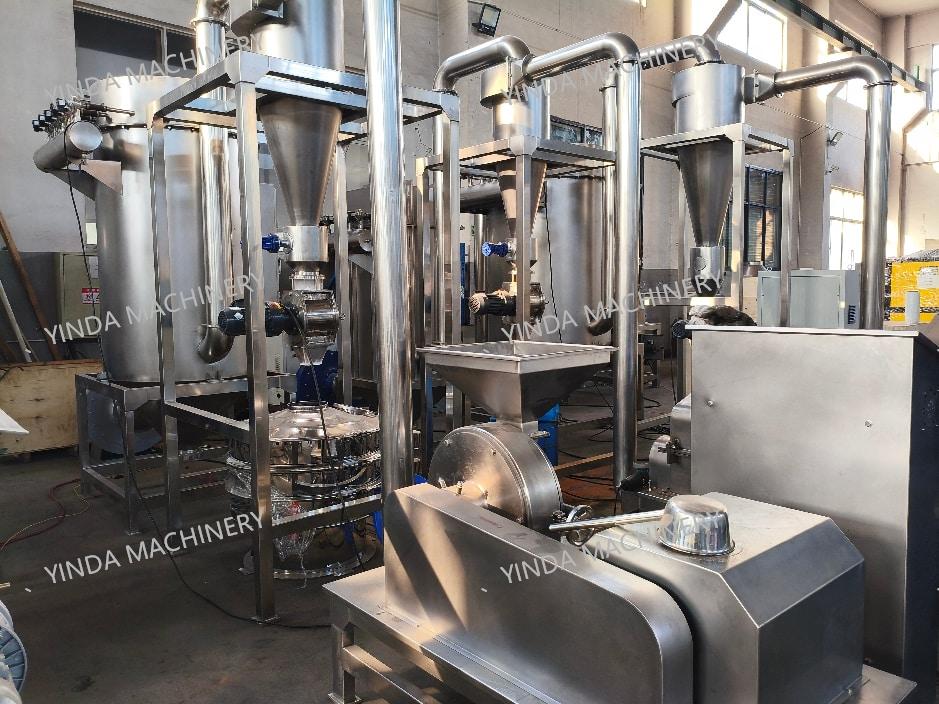
Ayurvedic Herbs Grinding Machine for Shivling Beej, Putrajeevak, Majuphal & Neem Bark
A staged coarse-crushing, pin-milling, and optional low-temperature solution for hard, fibrous, and partly oily Ayurvedic materials.
YDCS Coarse Crusher + YDWS Cyclone Dust-Free Pin Mill
5-20 mm flakes before fine grinding
20-120 mesh reference range
Air-cooled chiller for oily or heat-sensitive herbs
A practical industrial guide to grinding hard, fibrous Ayurvedic herbs into stable, uniform fine powder with protected active ingredients and consistent quality.
Ayurvedic herbal powders are widely used across herbal processing, botanical extraction, nutraceutical and pharmaceutical industries. However, many classic Ayurvedic materials — such as Shivling beej, Putrajeevak beej, Majuphal and Neem bark — are hard, woody, fibrous and partly oily. They cannot be pulverized efficiently in a single step. To produce a fine, uniform powder while preserving natural actives, aroma and color, these materials require a staged grinding solution. This article explains how to select the right equipment, why a two-stage coarse crusher plus pin mill line is the recommended approach, and when an air-cooled chiller should be added.
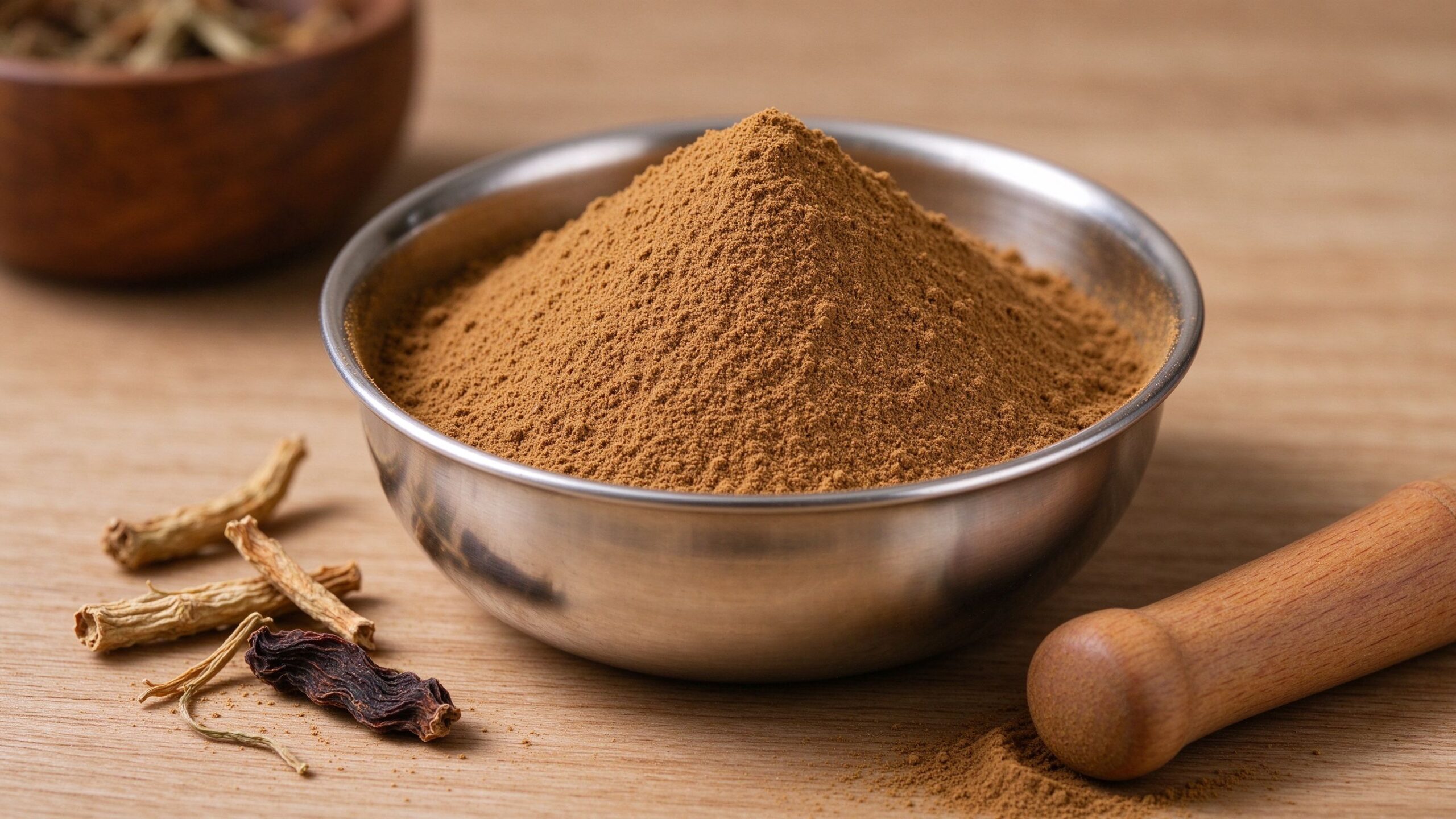
Processing Stages at a Glance
Stage 1 – Coarse Crushing: Reduce raw herbs into 5–20 mm flakes to stabilize feeding and relieve machine load.
Stage 2 – Fine Powder: Produce 20–120 mesh powder for blending, extraction and Ayurvedic herbal processing.
Stage 3 (Optional) – Low-Temperature Grinding: With an air-cooled chiller for oily, heat-sensitive herbs and higher-capacity production, protecting volatile oils and color.
1. Why a Complete Ayurvedic Herb Grinding Solution Is Needed
Ayurvedic herbal raw materials share several common characteristics: they are hard and woody, fibrous and irregular in size, and some contain moderate oil or volatile components that are sensitive to heat. Direct fine grinding of such materials usually reduces efficiency, increases machine load, creates unstable feeding conditions, and can overheat the powder — causing loss of volatile oils, aroma and natural color. A staged line keeps each machine within its optimal working range and improves consistency, yield and end-product quality.
The table below summarizes the four materials typically processed in one Ayurvedic herb line.
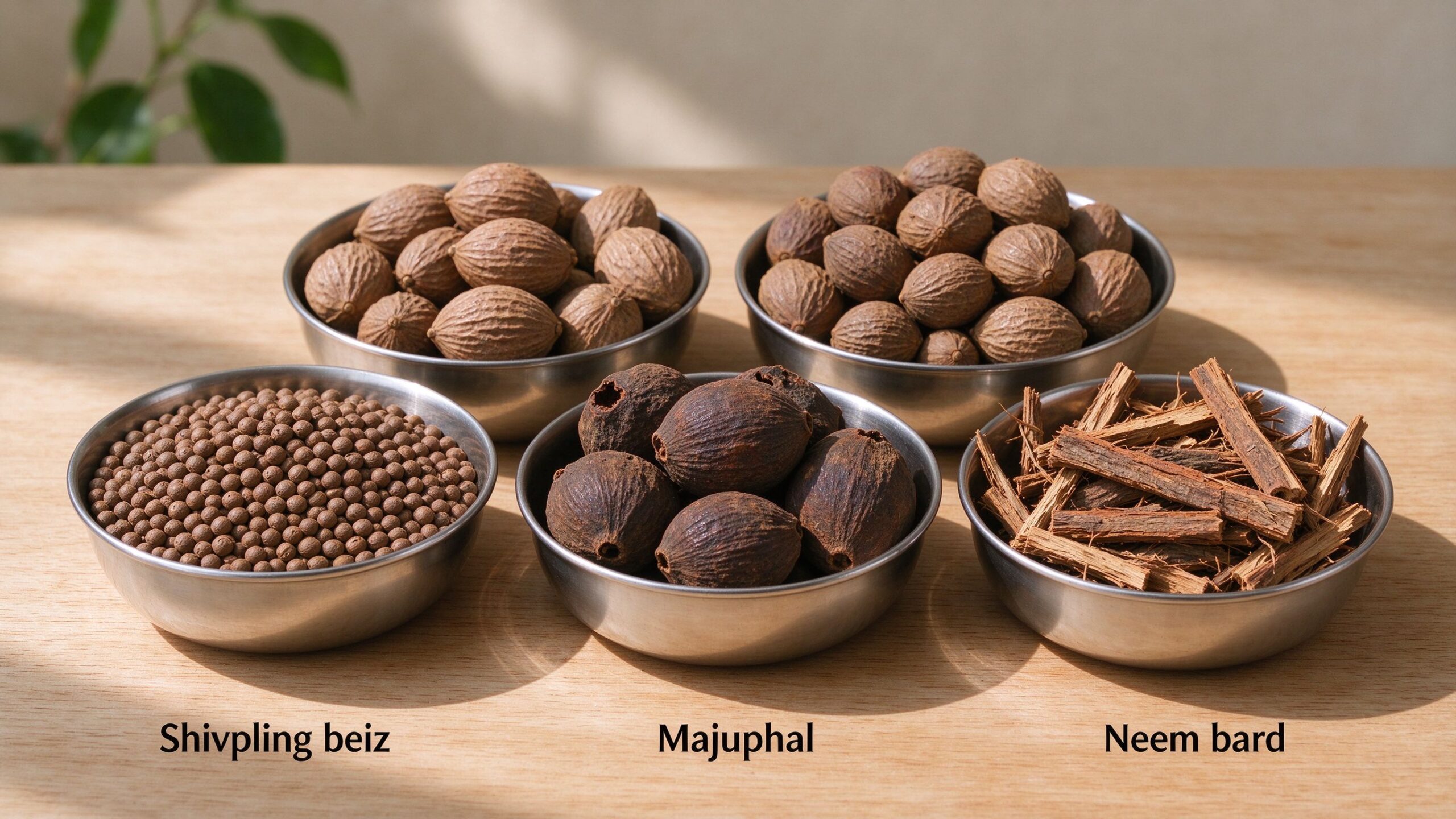
Table 1 – Typical Ayurvedic Herbs and Their Grinding Challenges
| Herb (Common Name) | Botanical Name | Part Used | Key Characteristics | Main Grinding Challenge |
|---|---|---|---|---|
| Shivling Beej (Shivlingi seed) | Bryonia laciniosa (also Diplocyclos palmatus) | Seeds | Hard woody seed coat; slightly oily; fertility and spermatogenic herb | Hard shell resists impact; needs pre-crushing to avoid clogging |
| Putrajeevak Beej | Putranjiva roxburghii | Seeds | Hard woody shell; fatty oil with mustard-like aroma; bitter | Oily kernel tends to smear and stick; low-temperature grinding helps |
| Majuphal (gall nut) | Quercus infectoria | Oak galls | Very hard, dense woody galls; 50–70% tannin; strongly astringent | Extremely hard and dense; requires coarse pre-break before fine milling |
| Neem Chhal (Neem bark) | Azadirachta indica | Bark | Fibrous, hard and irregular; bitter; antioxidant and antimicrobial | Fibrous structure lowers direct fine-grinding efficiency |
Because these herbs differ in hardness, fiber and oil content, a complete two-stage solution is usually more practical and stable than a single-machine approach.
2. Stage 1 – YDCS Series Coarse Crusher for Pre-Processing
Why Coarse Crushing Is Needed
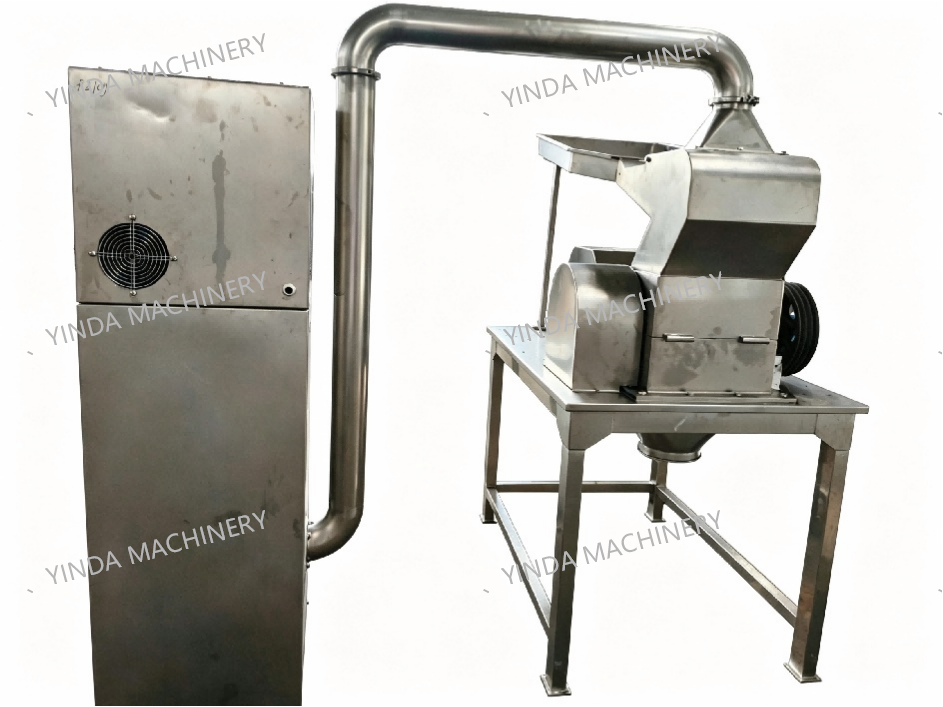
Raw Ayurvedic herbs are large, irregular, hard and fibrous.
Direct fine grinding reduces efficiency and increases machine load.
Pre-crushing improves feeding stability and processing continuity.
It also supports usable coarse-flake production, for example coarser Majuphal pieces for select applications.
Working Principle
The YDCS series consists of a feeding hopper, crushing chamber, rotating blades, fixed blades, discharge outlet and an optional dust collection system. Material is crushed through high-speed cutting, shearing and impact forces. Final particle size is controlled by the screen system, typically reducing herbs to 5–20 mm flakes ready for the next stage.
Key Features
Strong crushing ability for hard, fibrous plant materials.
Stable output size around 5–20 mm.
Suitable for both pre-crushing and coarse-flake production.
Stainless steel construction with polished, easy-to-clean surfaces.
Typical Applications
Bark, seeds, roots, herbs, spices and other fibrous plant materials across food, pharmaceutical and botanical processing industries.
Table 2 – YDCS Series Coarse Crusher Technical Parameters
| Model | Capacity (kg/hr) | Feeding Size (mm) | Output Size (mm) | Motor (kW) | Speed (r/min) |
|---|---|---|---|---|---|
| YDCS-100 | 10–80 | <80 | 5–20 | 1.5 | 960 |
| YDCS-200 | 100–200 | <100 | 5–20 | 4 | 960 |
| YDCS-300 | 200–300 | <100 | 5–20 | 5.5 | 960 |
| YDCS-400 | 300–400 | <100 | 5–20 | 11 | 960 |
| YDCS-600 | 500–600 | <100 | 5–20 | 15 | 960 |
| YDCS-800 | 800–1000 | <100 | 5–20 | 18.5 | 960 |
| YDCS-1000 | 1000–1200 | <100 | 5–20 | 22 | 960 |
Stage 2 – YDWS Series Cyclone Dust-Free Pin Mill for Fine Powder (20–120 Mesh)
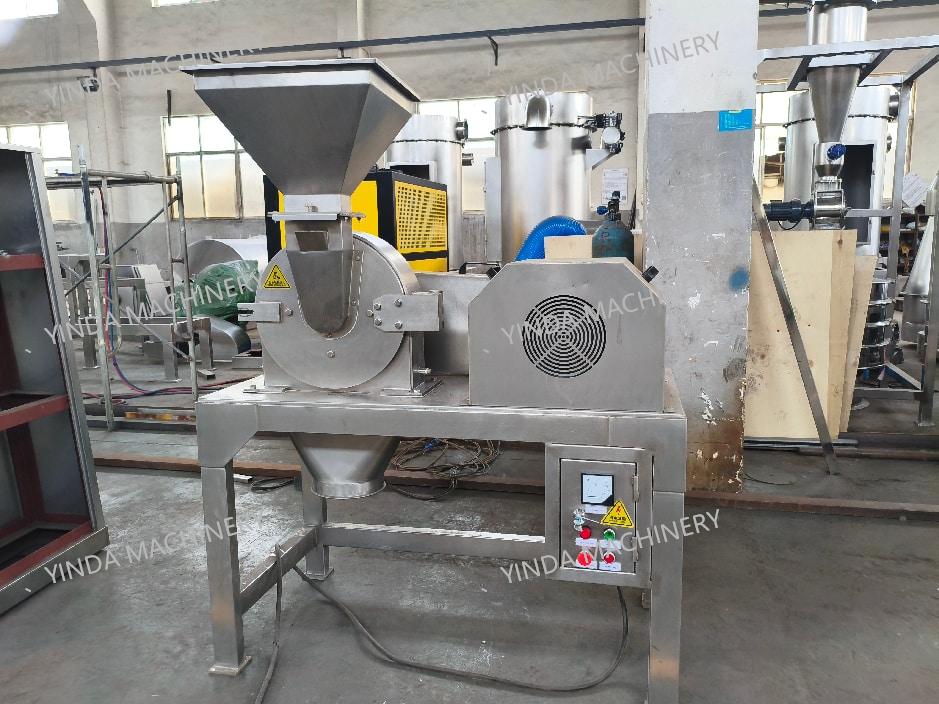
After coarse crushing, the herbs are ground into fine powder using the YDWS cyclone dust-free pin mill set. The 20–120 mesh range is widely used in Ayurvedic blending, extraction and herbal processing.
Working Principle
The system includes a grinding chamber, cyclone separator, pulse jet dust collection system, blower and connecting pipelines. Inside the chamber, two pin discs rotate at high speed. Material is crushed by high-speed impact and shearing between the rotating and fixed pins; centrifugal force together with the screen sieve controls the final fineness. The powder is carried by airflow to the cyclone discharge system, while fine dust is captured by the pulse filtration unit — delivering clean, dust-free production.
Watch the equipment or material test video
Watch the equipment or material test video
Key Features
Dust-free grinding system for cleaner production.
Adjustable fineness from 20–120 mesh.
Cyclone discharge with pneumatic vibration.
Easy cleaning and maintenance.
Suitable for food, pharmaceutical and chemical industries.
Typical Applications
Ayurvedic herbal powders, spices, seeds, roots, herbs and other dry brittle materials.
Table 3 – YDWS Series Cyclone Dust-Free Pin Mill Technical Parameters
| Model | Capacity (kg/hr) | Input Size (mm) | Output Size (mesh) | Total Power (kW) | System Size (mm) |
|---|---|---|---|---|---|
| YDWS-30 | 30–100 | ≤10 | 20–120 | 13.75 | 4200×900×2800 |
| YDWS-40 | 120–300 | ≤10 | 20–120 | 17.25 | 5900×1000×2900 |
| YDWS-60 | 200–600 | ≤12 | 20–120 | 41.25 | 6500×1300×3300 |
| YDWS-80 | 600–800 | ≤15 | 20–120 | 60.1 | 8000×2000×3700 |
| YDWS-100 | 800–1500 | ≤15 | 20–120 | 76.5 | 9000×2200×4000 |
| YDWS-120 | 1500–2500 | ≤15 | 20–120 | 146.5 | 10000×2500×4500 |
Optional – Air-Cooled Chiller for Low-Temperature Grinding
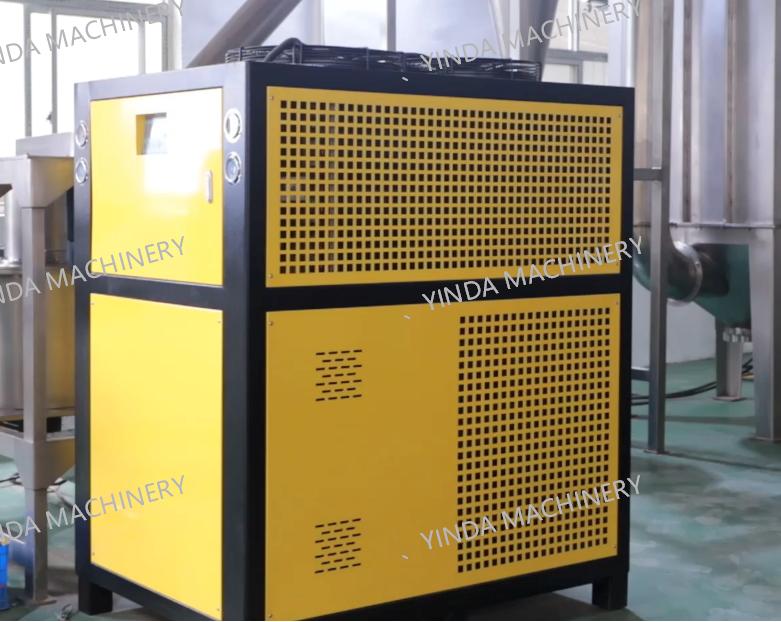
Oily seeds such as Shivling beej and Putrajeevak beej, and other heat-sensitive herbs, release natural oils during high-throughput grinding. These oils can smear onto the grinding discs, cause sticking, and raise the chamber temperature — which degrades volatile active compounds and natural color.
Adding an air-cooled chiller feeds cold air into the grinding system. This keeps the chamber temperature down, prevents gumming and sticking, and protects the aroma, essential oils and color of the final Ayurvedic powder. For higher-capacity lines producing premium herbal powders, the chiller is strongly recommended to ensure stable, high-quality output.
5. Design Note – Why We Place the Blower After the Dust Collector
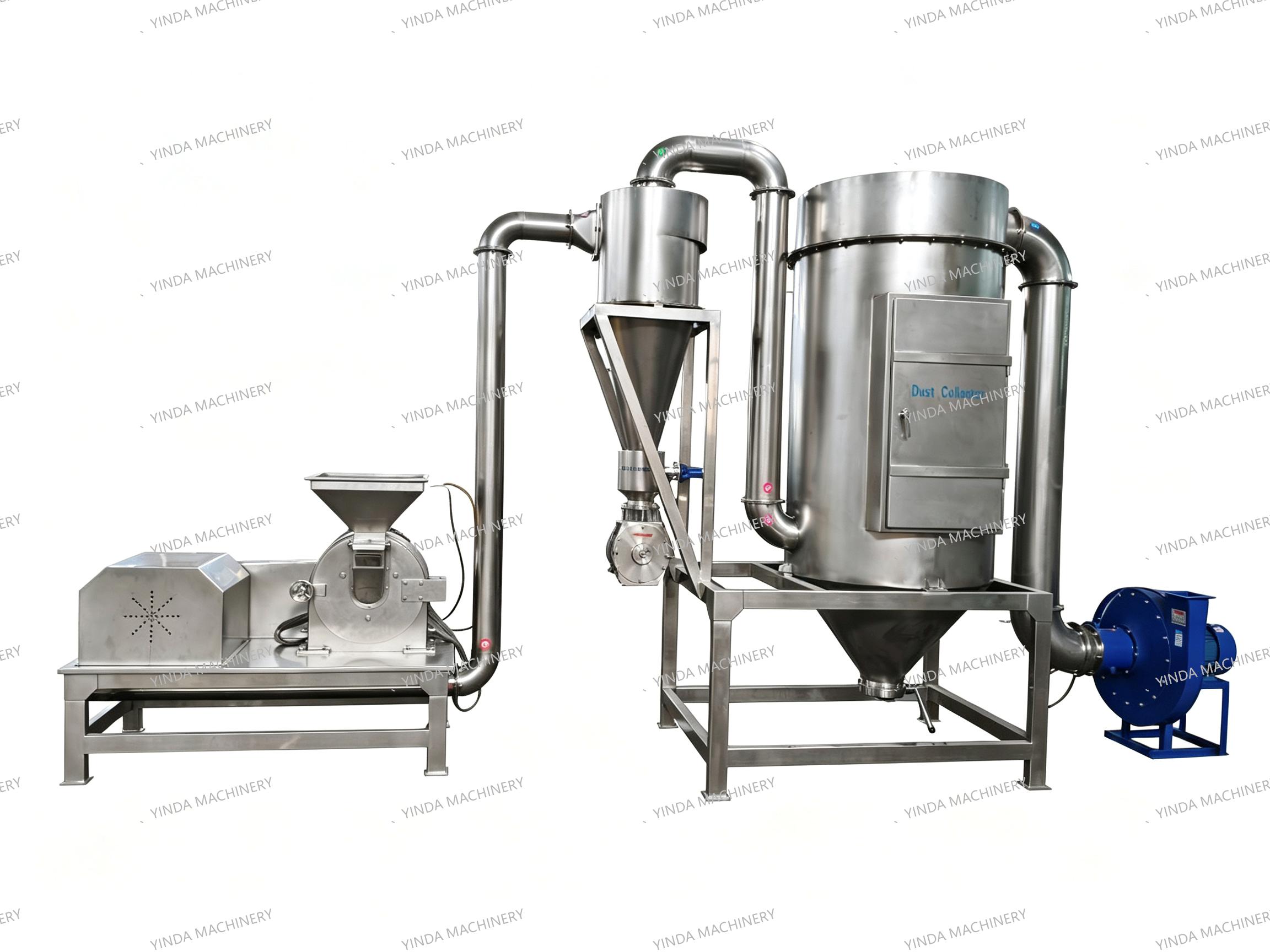
A customer recently asked: “In every machine, the blower location is different — isn’t this confusing to the customer?” It is a fair question. YINDA’s standard design adopts a blower-after-dust-collector configuration, and the reason is simple:
- Stable sealed negative pressure: On start-up, the high-pressure blower runs first, building a stable sealed negative pressure across the pulverizer, cyclone and filter housing. This prevents fine powder leaking from flanges, inspection doors and shaft seals.
- Clean-air blower for longer life: Because all dust is captured before it reaches the fan, the blower impeller handles only clean air. No abrasive powder flows across the wheel, so wear, powder build-up and vibration-related failures are minimized.
Alternative layouts — blower before the dust collector, or a positive-pressure blower before the cyclone — are functionally possible. However, in those configurations the fan is exposed to product dust. For abrasive, food-grade powders such as chili or woody herbal powder, this shortens blower service life and may introduce contamination risk over long-time operation. The blower-after-dust-collector design is therefore YINDA’s standard for clean, durable Ayurvedic herb lines.
6. Why Choose Yinda Machinery?
Yinda Machinery focuses on providing complete powder processing solutions for global customers across herbal, food, pharmaceutical and chemical industries.
Customized process design based on raw materials such as Ayurvedic herbs, bark and seeds.
Complete system integration from feeding to final packaging.
Equipment selection and engineering support.
Stable, industrial-grade machinery manufacturing.
Global technical support for food and herbal industries.
7. FAQ – Ayurvedic Herb Powder Processing
Can these herbs be ground directly into fine powder in one step?
Generally, pre-treatment is recommended before fine grinding. For hard, fibrous and oily herbs, a two-stage coarse crusher plus pin mill line is more stable and efficient than a single step.
Can Yinda Machinery provide a complete system?
Yes. Yinda provides customized turnkey solutions including feeding, grinding, conveying, sieving, mixing and packaging.
Can I test my material before purchasing?
Yes. Sample testing and machine evaluation are available so you can verify suitability before final equipment confirmation.
Do you support overseas service?
Yes. All equipment is tested before shipment. Yinda provides remote guidance, video support and on-site installation service when required.
Get a Customized Powder Processing Solution
Please share your raw material, feeding size, target particle size, required capacity, moisture or oil content, heat sensitivity, voltage, cleaning requirements, and final application. Yinda Machinery will evaluate a suitable configuration.
Your Powder Processing Contact
Dennie Yuan | Powder Processing Solution Specialist
Email: dennie@yindamachinery.com
WhatsApp / WeChat: +86-13914192807
Website: www.yindapowdertec.com