
Clove Grinding Machine for 40–60 Mesh Clove Powder: YDGS Hammer Mill with Air Cooling Chiller
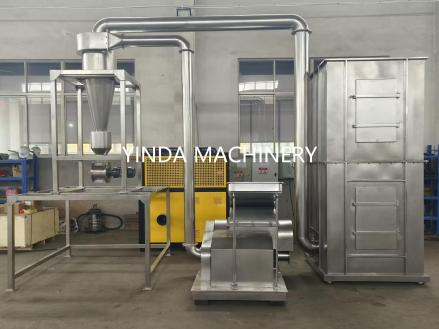
Clove Grinding Machine for 40–60 Mesh Clove Powder: YDGS Hammer Mill with Air Cooling Chiller
A YDGS cyclone dust-free hammer mill solution with optional air cooling for aromatic 40-60 mesh clove powder production.
YDGS Cyclone Dust-Free Hammer Mill
40-60 mesh, subject to material testing
Air cooling chiller for process-temperature management
Volatile aroma, natural oils, color, and grinding heat
Quick Answer: Which Machine Is Suitable for Grinding Cloves to 40–60 Mesh?
If you need to grind dried cloves into 40–60 mesh clove powder, Yinda Machinery recommends the YDGS Cyclone Dust-free Hammer Mill combined with an optional air cooling chiller to form a temperature-controlled grinding system.
Cloves are aromatic spice buds containing volatile essential oils. During high-speed grinding, friction and impact can generate heat, potentially affecting their natural aroma, color, and volatile components. The YDGS hammer mill uses interchangeable screens to control particle size, while the air cooling chiller can lower the temperature of the circulating airflow to help manage heat during grinding.
This combination is suitable for spice processors, food manufacturers, ingredient suppliers, and other businesses that need to produce clove powder with a target particle size of 40–60 mesh.
The final particle size and production capacity depend on the characteristics of the cloves, moisture content, feeding conditions, screen aperture, and operating parameters. Yinda Machinery recommends conducting a material test before confirming the final equipment configuration.
Recommended solution: YDGS Hammer Mill + Air Cooling Chiller (Optional).


Cloves: Characteristics and Applications
Cloves are the dried flower buds of the clove tree. They are widely used in the food, beverage, spice, pharmaceutical, and personal care industries. Their distinctive aroma and flavor make them an important raw material for a variety of products.
Common applications of cloves include:
Food and seasoning: Clove powder is used in spice blends, sauces, marinades, baked goods, meat products, and seasoning formulations.
Beverages: Ground cloves are used in teas, herbal infusions, and traditional beverage formulations.
Food ingredient manufacturing: Cloves are processed into powders and blended with other spices to produce customized ingredients.
Pharmaceutical and herbal applications: Cloves are used in certain traditional herbal preparations and related ingredient-processing applications.
Essential oil and fragrance applications: Cloves contain aromatic volatile compounds that are relevant to essential oil extraction and fragrance-related industries.
With growing demand for standardized spice ingredients, manufacturers may need to grind whole cloves into powders with consistent particle sizes. Choosing a suitable clove grinding machine helps improve processing efficiency and supports downstream screening, blending, packaging, and formulation.
What Makes Clove Grinding Challenging?
Grinding cloves requires more consideration than simply reducing the size of a dry raw material. Their aromatic compounds, physical characteristics, and desired final particle size all influence equipment selection and operating conditions.
1. Volatile aromatic compounds
Cloves contain volatile aromatic compounds, including eugenol, which contributes significantly to their characteristic aroma. Excessive heat during grinding may increase the loss of volatile components. A suitable temperature-control strategy is therefore important when processing aromatic spices.
2. Heat generation during grinding
High-speed impact, friction, and repeated collisions inside the grinding chamber generate heat. As the material becomes finer, the operating conditions may need to be adjusted to balance particle size, throughput, and temperature.
An air cooling chiller can help lower the circulating airflow temperature and manage heat accumulation in the grinding system. Actual material temperatures depend on the complete process configuration and operating conditions.
3. Target particle size of 40–60 mesh
Different applications require different powder fineness. For clove powder with a target particle size of 40–60 mesh, the screen aperture and grinding parameters must be selected according to the raw material and the required product specification.
Mesh size is associated with sieve openings, and the corresponding aperture depends on the applicable sieve standard. A 40–60 mesh target should therefore be confirmed using the customer's specified sieve standard and, where necessary, particle-size testing.
4. Aroma and color preservation
For spice processors, preserving the natural aroma and color of cloves is an important quality consideration. Appropriate temperature management, suitable screen selection, and controlled feeding can help reduce undesirable changes during processing.
5. Continuous production and dust control
Industrial spice processing often requires stable feeding, continuous grinding, convenient discharge, and effective dust collection. An integrated grinding and separation system can support cleaner operation and improve material recovery.
For these reasons, a hammer mill equipped with an appropriate screen and an optional air cooling chiller is a practical solution to evaluate for clove grinding.
YDGS Hammer Mill for Cloves and Other Oily Spices
The YDGS Cyclone Dust-free Hammer Mill is an upgraded high-efficiency hammer-type grinding system developed from the original YDWS Universal Grinder. It integrates impact grinding with pneumatic conveying and is designed for continuous processing and medium-fineness powder production.
Yinda Machinery's YDGS hammer mill is suitable for pharmaceutical, food, chemical, spice, and agricultural processing applications. It is particularly suitable for fibrous materials, crystalline materials, brittle materials, and selected materials containing oil or moisture.
The YDGS series is designed for grinding spices with an oil content of approximately 10%–20%, subject to material characteristics and process testing. Typical applications include chili peppers, sweet peppers, various plant seeds, oily materials, and fibrous materials.
For clove processing, the machine can be configured with an appropriate screen to target 40–60 mesh powder. When heat management is important, an optional air cooling chiller can be integrated into the system.
Key advantages include:
Adjustable particle size: Different screen apertures can be selected to meet different powder-fineness requirements.
Temperature management: An optional air cooling chiller helps lower the circulating airflow temperature during grinding.
Aroma and color considerations: Temperature-controlled processing helps manage heat-related changes in aromatic spices.
Continuous operation: The system supports continuous feeding, grinding, separation, and discharge under suitable operating conditions.
Enclosed dust collection: A cyclone separator and dust collector help reduce dust leakage and recover fine material.
Hygienic construction: Product-contact components are made of food-grade stainless steel, with a design based on GMP principles.
Convenient maintenance: The compact structure supports disassembly, cleaning, inspection, and routine maintenance.
For manufacturers looking for a clove powder production line, Yinda Machinery can help evaluate the required configuration based on the raw material, target mesh size, expected throughput, and processing conditions.
Watch the equipment or material test video
Particle Size Control, Color, Aroma, and Continuous Grinding
The particle size of the YDGS hammer mill is controlled by the screen installed in the grinding chamber. By selecting screens with different apertures and adjusting the operating conditions, the machine can be configured for a range of powder sizes, typically around 20–100 mesh, depending on the material and processing requirements.
For customers targeting 40–60 mesh clove powder, the appropriate screen and operating parameters should be established through material testing. The relationship between screen aperture and the final particle-size distribution is influenced by the raw material and the selected sieve standard.
The YDGS system is designed for continuous operation under suitable processing conditions. When equipped with an air cooling chiller, the system can help control the temperature of the circulating airflow and reduce heat accumulation during grinding.
This temperature-control approach is particularly relevant to aromatic spices such as cloves, where excessive heat may affect the retention of natural aroma and color. With suitable equipment configuration and process parameters, the system can help maintain the original appearance and characteristic aroma of the material.
Other practical benefits include convenient operation, relatively low operating noise, effective grinding performance, and an integrated dust collection system. Actual noise levels, product quality, and production capacity depend on the specific model, installation, raw material, and operating conditions.
| Model | YDGS-400 | YDGS-600 | YDGS-800 | YDGS-1000 |
|---|---|---|---|---|
| Capacity(kg/h) | 80-300 | 300-500 | 400-1000 | 800-1500 |
| Feeding size(mm) | <20 | <20 | <20 | <20 |
| Particle size(mm) | 20-100 | 20-100 | 20-100 | 20-100 |
| Grinding Motor(kw) | 22 | 22 | 37 | 45 |
| Dimension(mm) | 5400*1300*2700 | 6800*1320*2700 | 7800*1800*3200 | 8800*2000*3300 |

Stainless Steel Construction and GMP-Oriented Design
Hygiene and cleanability are important considerations when grinding spices and other ingredients intended for food, pharmaceutical, or chemical applications.
The YDGS hammer mill uses stainless steel for its main product-contact components. Its grinding chamber features a machined inner surface designed to be smooth and easier to clean. Compared with rough internal surfaces that may allow powder to accumulate, a smoother finish can help reduce material buildup and simplify routine cleaning.
The machine is designed in accordance with GMP principles, with attention to hygienic construction, convenient disassembly, and maintenance accessibility. These features are important for manufacturers that need to manage cross-contamination risks and maintain consistent cleaning procedures between batches.
For food and spice processors, stainless steel construction also supports routine sanitation and inspection. The actual material grade, surface finish, sealing arrangement, and applicable compliance documentation should be confirmed according to the selected configuration and the customer's regulatory requirements.

What Materials Can the YDGS Hammer Mill Process?
In addition to cloves, the YDGS hammer mill can be evaluated for grinding a wide range of spices, herbs, seeds, and other suitable raw materials.
Typical materials include:
Chili peppers and sweet peppers
White pepper and black pepper
Cinnamon
Cumin
Sichuan pepper
Nutmeg and cardamom
Garlic
Star anise
Cloves
Thyme
Turmeric
Dried ginger
Other suitable Chinese herbal materials
Selected plant seeds, oily materials, and fibrous materials
Other brittle or crystalline materials compatible with the equipment configuration
The suitability of each material depends on its oil content, moisture content, fiber structure, hardness, temperature sensitivity, and target particle size. Material testing is recommended before selecting the final screen, cooling configuration, and production capacity.
Watch the equipment or material test video
Main Structure of the YDGS Series Hammer Mill
The YDGS Series Hammer Mill features a horizontal-shaft structure. Its main components include the feeding hopper, grinding chamber, discharge hopper, and machine base.
The grinding chamber contains the door cover, bearing housing, hammers, main shaft, bearings, liner plate, and screen assembly. These components work together to support high-speed impact grinding and particle-size control.
During operation, the main shaft drives the hammers to rotate at high speed. Materials entering the chamber are rapidly reduced in size through impact from the moving hammers, interaction with the fixed components, friction, and inter-particle collisions.
The ground material is classified by the screen. Particles that can pass through the screen are discharged, while larger particles remain in the grinding chamber for further size reduction. The final particle-size distribution depends on the selected screen, raw material characteristics, feed rate, and operating parameters.
The airflow generated by the system fan helps convey the ground material and can contribute to internal air circulation and cooling. When an air cooling chiller is integrated into the system, additional control of the process airflow temperature is possible.
Downstream, the cyclone separator performs gas-solid separation, and the dust collector captures fine particles that remain in the airflow. This arrangement supports enclosed material handling, efficient powder collection, and a cleaner working environment.
Watch the equipment or material test video
YDGS Low-Temperature Grinding System with an Air Cooling Chiller
For heat-sensitive and aromatic materials such as cloves, Yinda Machinery can configure the YDGS hammer mill with an optional air cooling chiller.
The complete system can include:
YDGS hammer mill
Cyclone separator
High-pressure induced draft fan
Electric control cabinet
Air cooling chiller (optional)
After grinding in the main unit, the material passes through the selected screen and is conveyed by negative-pressure airflow into the cyclone separator for separation and discharge. Fine dust is captured by the dust collection unit.
The optional air cooling chiller lowers the temperature of the circulating or process airflow, helping manage heat generated during grinding. This can be beneficial when processing aromatic spices or oily materials for which temperature control is an important consideration.
The required cooling capacity depends on the material, feed rate, grinding intensity, ambient conditions, airflow, and desired process temperature. The chiller model and system configuration should therefore be selected according to the customer's actual processing requirements.
Yinda Machinery can help evaluate the appropriate grinding and cooling configuration through material testing and process consultation.
Why Choose a Hammer Mill with Low-Temperature Grinding for Cloves?
When selecting a clove grinding machine, manufacturers need to consider more than particle size alone. Aroma retention, color stability, production efficiency, and dust management can all influence the quality and economics of the final product.
1. Help preserve the natural color and aroma
Cloves contain volatile aromatic compounds that can be affected by processing conditions. By combining the YDGS hammer mill with an air cooling chiller, manufacturers can better manage grinding temperature and help reduce undesirable heat-related changes. Actual results should be verified through material testing.
2. Support temperature-controlled grinding
The air cooling chiller helps lower the process airflow temperature. This is useful when grinding aromatic spices and selected oily materials that may be sensitive to heat generated by friction and impact.
3. Improve production efficiency through appropriate configuration
The YDGS hammer mill supports continuous feeding and grinding under suitable operating conditions. Correct screen selection, feed-rate adjustment, and an appropriately configured cooling system can help balance throughput and target particle size.
Actual production capacity depends on the raw material, target fineness, equipment model, screen aperture, and operating conditions. A material test is the best way to estimate achievable throughput for a specific clove-processing application.
4. Improve dust collection and material recovery
The cyclone separator and dust collection unit help capture powder carried by the airflow. This supports cleaner production, reduces dust leakage, and helps recover fine material.
5. Simplify cleaning and maintenance
The stainless steel construction and accessible components support routine cleaning, inspection, and maintenance. These features are particularly relevant to spice processors handling different raw materials or product formulations.
For manufacturers targeting 40–60 mesh clove powder, the YDGS hammer mill with an optional air cooling chiller offers a practical configuration to evaluate through a material test.

Frequently Asked Questions About Clove Grinding Machines
Q1. Which machine is suitable for grinding cloves into 40–60 mesh powder?
Yinda Machinery recommends evaluating the YDGS Cyclone Dust-free Hammer Mill with an optional air cooling chiller. The screen controls the particle size, while the cooling system helps manage heat during grinding. Final performance should be confirmed through a material test.
Q2. Can the YDGS hammer mill produce 40–60 mesh clove powder?
The YDGS hammer mill uses interchangeable screens to control grinding fineness and can be configured for a range of particle sizes. Whether a specific configuration can meet the required 40–60 mesh specification depends on the cloves and the processing conditions. Yinda Machinery recommends testing the actual material before confirming the final configuration.
Q3. Why is an air cooling chiller recommended for clove grinding?
Cloves contain volatile aromatic compounds, and grinding generates heat through impact and friction. An air cooling chiller helps lower the process airflow temperature and manage heat accumulation, which can help protect product quality. The required cooling configuration depends on the material and operating conditions.
Q4. Will clove powder change color during grinding?
Color changes depend on the raw material, temperature, moisture content, and processing conditions. The YDGS hammer mill can be combined with an air cooling chiller to help manage temperature and reduce the risk of undesirable heat-related changes. Color retention should be verified through testing with the customer's cloves.
Q5. What mesh sizes can the YDGS hammer mill achieve?
Depending on the material and process requirements, the YDGS hammer mill can typically be configured for approximately 20–100 mesh using different screen apertures. The achievable particle-size distribution depends on the raw material, selected screen, and operating parameters.
Why Choose Yinda Machinery for Clove Grinding Equipment?
Selecting an industrial clove grinding machine involves more than purchasing a standalone grinder. Manufacturers also need to consider material testing, process integration, equipment configuration, cleaning requirements, and after-sales support.
Yinda Machinery works with customers to evaluate grinding solutions according to their specific production requirements.
Customized equipment recommendations
Different cloves and spice materials may require different screen apertures, feeding arrangements, cooling capacities, and collection systems. Yinda Machinery can help evaluate these requirements and recommend a suitable configuration based on the material and target product specification.
Free material testing
Yinda Machinery offers free material testing for customers to evaluate the grinding performance of their raw materials. Customers can send representative samples for testing. The results help assess achievable particle size, material characteristics, and the suitability of the proposed equipment configuration. Specific testing arrangements can be confirmed with the sales team.
Testing before shipment
Before shipment, the equipment can be tested to verify its operation and the agreed requirements. The shipment process should proceed after the relevant acceptance criteria have been met, in accordance with the confirmed order and testing arrangements.
Integrated processing equipment
Beyond hammer mills, Yinda Machinery can provide supporting equipment such as mixing machines, vibrating screens, drying ovens, and conveying equipment. This allows customers to discuss a more integrated processing solution with one equipment supplier.
Practical support for international customers
For customers who need to produce 40–60 mesh clove powder, Yinda Machinery can help assess the raw material, required capacity, target fineness, temperature-control requirements, and downstream processing needs.
Conclusion: Find the Right Clove Grinding Solution with Yinda Machinery
Producing 40–60 mesh clove powder requires suitable grinding equipment, appropriate screen selection, and careful management of processing conditions. Because cloves contain volatile aromatic compounds, temperature control is an important consideration when selecting an industrial clove grinding machine.
Yinda Machinery recommends evaluating the YDGS Cyclone Dust-free Hammer Mill with an optional air cooling chiller for clove grinding applications. The system combines screen-based particle-size control, continuous grinding under suitable conditions, pneumatic conveying, cyclone separation, and dust collection. Its stainless steel construction and GMP-oriented design also support the hygiene requirements of spice and ingredient processing.
The most suitable configuration depends on the raw material, required particle size, production capacity, and temperature-control requirements. Yinda Machinery offers free material testing to help customers evaluate equipment suitability before making a purchasing decision.
Looking for a clove grinding machine for 40–60 mesh clove powder? Contact Yinda Machinery to discuss your raw material, target fineness, and production requirements. Send us a sample for testing and let our team help you evaluate a suitable grinding solution.
Contact us either by email: dennie@yindamachinery.com or catch us on WhatsApp: 0086-13914192807.
Our products page:https://www.yindamachinery.com/ can also give you a lot of information.

Get a Customized Powder Processing Solution
Please share your raw material, feeding size, target particle size, required capacity, moisture or oil content, heat sensitivity, voltage, cleaning requirements, and final application. Yinda Machinery will evaluate a suitable configuration.
Your Powder Processing Contact
Dennie Yuan | Powder Processing Solution Specialist
Email: dennie@yindamachinery.com
WhatsApp / WeChat: +86-13914192807
Website: www.yindapowdertec.com