
How to Grind Coconut Oil Cake into Coconut Powder: A Complete Guide to Selecting the Right Grinding Machine
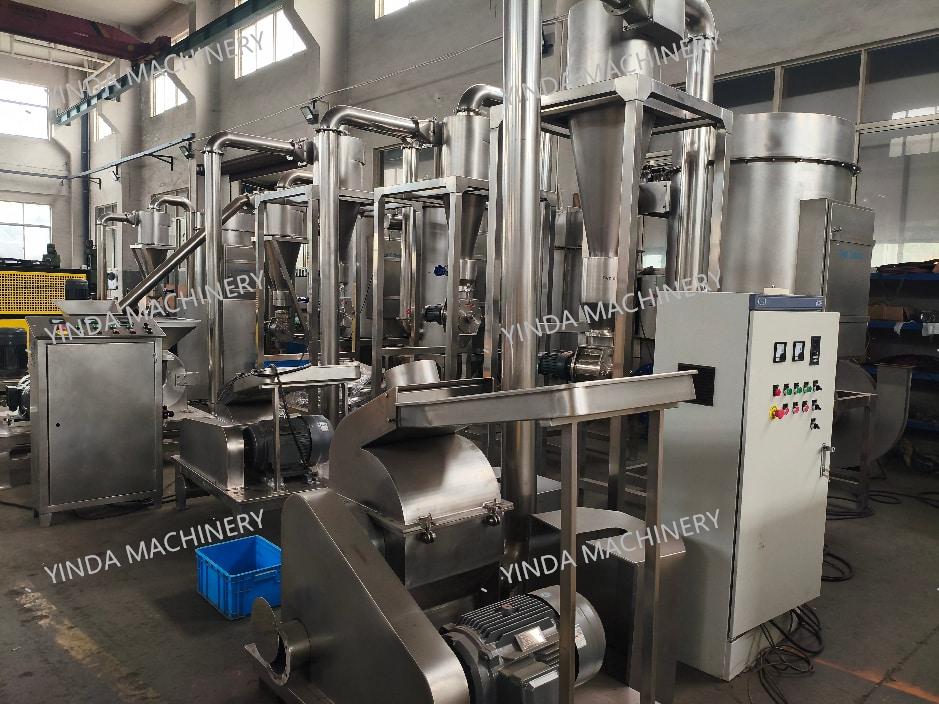
YINDA Powder Processing Solution
How to Grind Coconut Oil Cake into Coconut Powder: A Complete Guide to Selecting the Right Grinding Machine
Select a low-temperature hammer mill or a two-stage coarse-crushing and air-classifier-milling line for coconut oil cake powder.
By Yinda Machinery
Coconut powder is one of the most versatile ingredients in the global food industry. From bakery fillings and confectionery coatings to instant coconut milk, smoothie blends, dairy products and nutritional supplements, coconut powder delivers tropical flavor, natural fat, dietary fiber and clean-label appeal. Behind every consistent batch of coconut powder, however, is a critical processing step: grinding. The right grinding solution determines not only particle size and uniformity, but also production efficiency, yield and final product quality.
In this guide, we explain why coconut oil cake (also called coconut meal) is the preferred raw material for powder production, what fineness different applications require, and how to choose the right grinding equipment – from the YDGS Series hammer mill to a two-stage coarse crusher plus YDWF Series air classifier mill (ACM) solution.
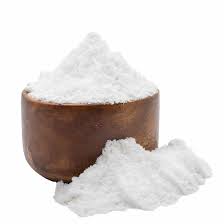
1. Why Start from Coconut Oil Cake (Coconut Meal)?
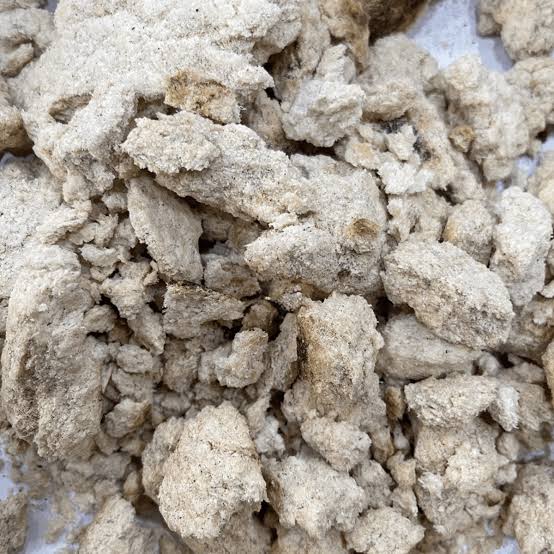
Before powder can be produced, the coconut meat must be prepared correctly. Fresh or dried coconut meat (copra) contains a high oil content – dried coconut meat typically contains around 60-70% oil. If such oily material is fed directly into a mill, the oil tends to smear, coat the hammers and screens, and make the powder stick inside the grinding chamber, eventually blocking the screen and interrupting production.
This is why coconut meat is usually oil-pressed first. After mechanical oil pressing (expeller pressing), the remaining material – coconut oil cake, also called coconut meal – has a much lower oil content, typically 8-15% after single pressing (and as low as 5-8% after double pressing). With most of the oil removed, the cake becomes dry enough to be ground continuously and smoothly without clogging the mill.
Key benefits of starting from coconut oil cake:
• Much lower oil content – the powder does not stick, smear or clog the mill
• Stable, continuous production with less downtime and fewer screen blockages
• Consistent feeding into downstream grinding equipment
• A valuable co-product: the pressed coconut oil is sold separately, improving overall plant profitability
2. Coconut Powder Applications and Target Fineness
The fineness of coconut powder should be selected according to its final application. Different applications require different particle sizes, and matching the grinding solution to the target fineness is the key to product quality and production efficiency.
Table 1 Coconut Powder Applications and Typical Fineness
Source reference specifications; final model and performance should be confirmed for the actual material.
| Application | Typical Fineness | Typical Uses |
|---|---|---|
| Bakery and snack inclusions | 20-60 mesh | Toppings, coatings, granola bars, protein bars, dessert decorations |
| Baking mixes and dough | 40-80 mesh | Cakes, cookies, muffins, bread, pastry fillings |
| Confectionery and dairy | 80-100 mesh | Chocolate fillings, candies, ice cream, yogurt, non-dairy creamers |
| Beverages and instant products | 100-200 mesh | Instant coconut milk, smoothies, coffee creamers, protein shakes |
| Supplements and capsules | 80-120 mesh | Nutritional blends, supplement powders, capsule filling |
Note: Mesh numbers above are indicative; exact targets depend on the recipe and customer specification.
3. YDGS Series Hammer Mill – Low-Temperature Grinding for 20-60 Mesh
When the required fineness is 20-60 mesh – typical for coarse coconut powder used in bakery inclusions, snack coatings and food granules – Yinda recommends the YDGS Series Hammer Mill.
Working Principle
Dried coconut oil cake is fed into the grinding chamber, where high-speed rotating hammers repeatedly impact and shear the material. The powder passes through an interchangeable screen that controls the final particle size, and is then conveyed by airflow to a cyclone separator for collection, while ultra-fine dust is captured by a pulse dust collector.
Watch the related YINDA equipment video
Why It Fits Oily Materials
Compared with fine-impact grinding systems, the YDGS hammer mill operates with a lower chamber temperature. This is a key advantage for coconut cake, whose residual oil can soften or melt under excessive heat. The lower temperature keeps the material free-flowing, reduces smearing and agglomeration, and allows continuous grinding without screen blockage.
Ideal Use
• Coarse to medium coconut powder at 20-60 mesh (up to 100 mesh with screen adjustment)
• Oily materials with an oil content below15%
• Medium-scale to industrial production
Key Features
• Screen-controlled fineness, easily adjusted by changing the screen
• Low-temperature operation protects oil-bearing materials
• Continuous production with cyclone separation and pulse dust collection
• Stainless steel construction (SS304/SS316L) for food-grade processing
Table 2 YDGS Series Hammer Mill Technical Specifications
Source reference specifications; final model and performance should be confirmed for the actual material.
| Parameter | Specification |
|---|---|
| Model Options | YDGS-300/YDGS-400 / YDGS-600 / YDGS-800 / YDGS-1000 |
| Production Capacity | 80-300 kg/h |
| Feeding Size | < 20 mm |
| Output Size | 20-100 mesh (adjustable by screen) |
| Material Compatibility | Dry, brittle and low-oil materials (oil content < 15%) |
| Machine Material | SS304 / SS316L (optional) |
| System Design | Cyclone separator + pulse dust collector |
4. Two-Stage Fine Grinding for 80-200 Mesh – YDCS Coarse Crusher + YDWF Air Classifier Mill
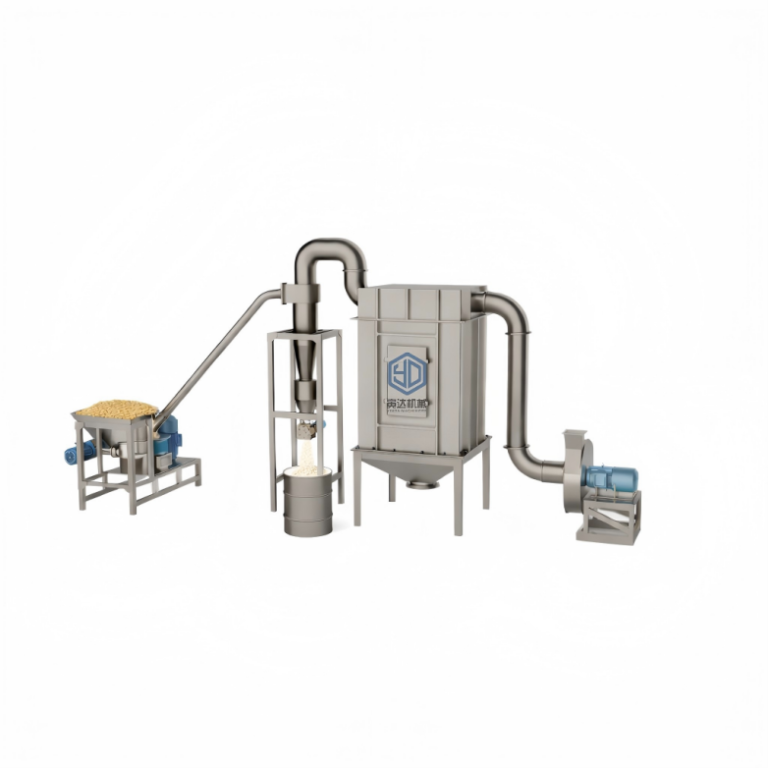
When the application requires finer powder – typically 80-200 mesh for beverages, confectionery fillings, dairy products and supplements – Yinda recommends a two-stage grinding solution: first reduce the coconut oil cake into small granules with a coarse crusher, then feed the granules into the YDWF Series Air Classifier Mill (ACM).
Why Two-Stage Grinding?
Feeding large cake chunks directly into an air classifier mill creates an uneven load and reduces grinding uniformity. By pre-crushing the oil cake into uniform small granules (5-20 mm), the ACM receives a consistent feed, which:
• Makes the final ACM grinding more uniform
• Protects the ACM from overloading and reduces wear
• Improves overall system efficiency and powder consistency
Stage 1 – YDCS Series Coarse Crusher
The YDCS coarse crusher uses a combination of rotating and fixed blades to cut, shear and crush large coconut cake chunks. Material is broken down by the high-speed blades and discharged through a screen once it reaches the desired size (typically 5-20 mm granules).
• First-stage size reduction for large, bulky materials
• Uniform granules for stable downstream feeding
• Stainless steel construction for food-grade processing
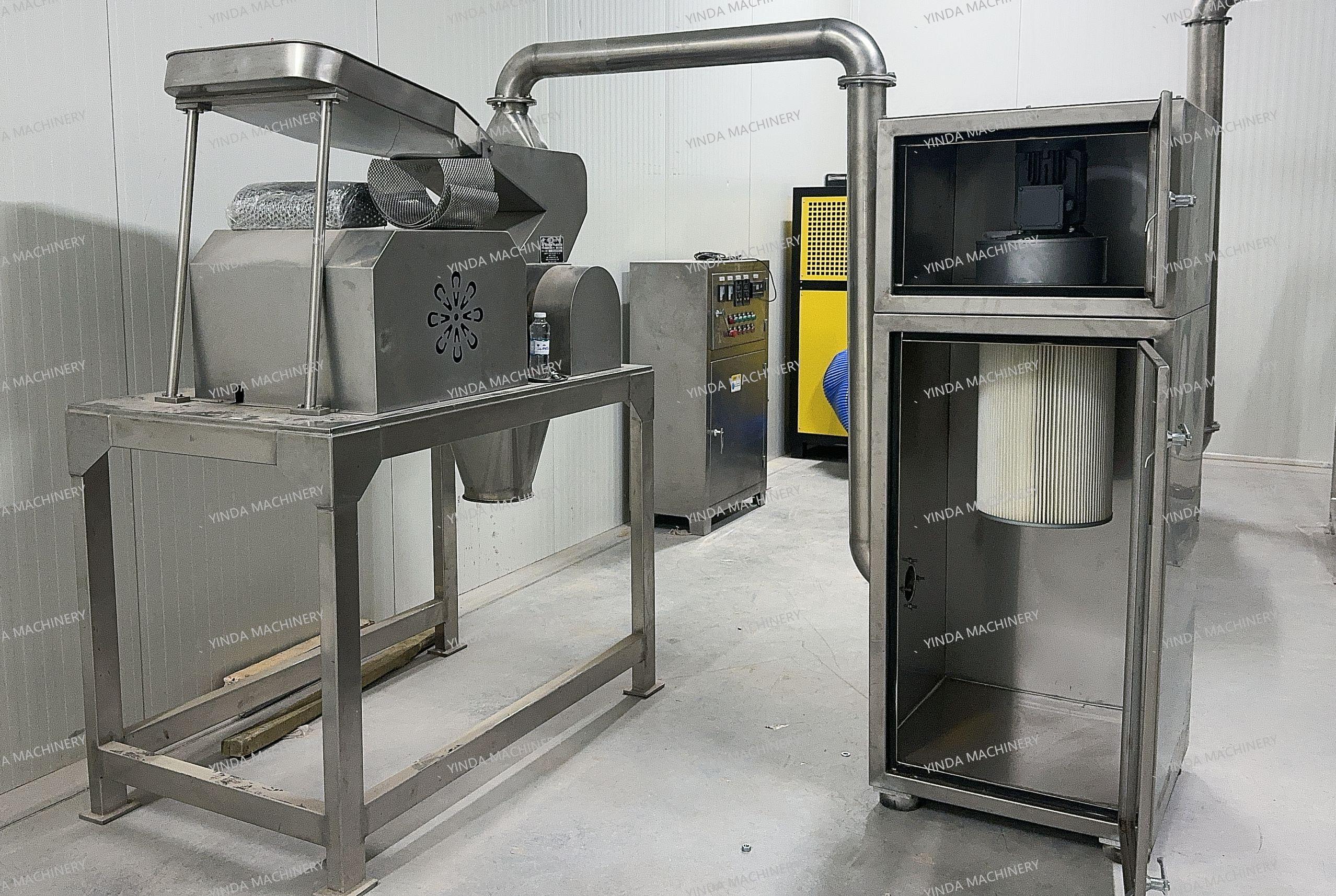
Stage 2 – YDWF Series Air Classifier Mill (ACM)
The YDWF Series Air Classifier Mill integrates impact grinding and air classification in a single closed-loop system:
• High-speed blades pulverize the granules inside the milling chamber
• An integrated classifier wheel separates fine particles from coarse ones
• Qualified powder is discharged immediately, while oversized particles return to the grinding chamber for re-grinding
• No screen is required – fineness is controlled by the classifier, producing a narrow and uniform particle size distribution
For coconut powder, the YDWF ACM typically produces 80-200 mesh (and up to 100-500 mesh depending on configuration), with an even granularity ideal for beverages, dairy and supplement applications.
Watch the related YINDA equipment video
Table 3 YDWF Series Air Classifier Mill Technical Specifications
Source reference specifications; final model and performance should be confirmed for the actual material.
| Parameter | Specification |
|---|---|
| Model Options | YDWF-15 / YDWF-20 / YDWF-30 / YDWF-40 / YDWF-60 / YDWF-80 / YDWF-100 / YDWF-120 |
| Production Capacity | 30-1300 kg/h (by model) |
| Feeding Size | <= 15 mm |
| Fineness | 100-500 mesh (40-100 um), adjustable |
| Grinding Motor | 11-55 kW (by model) |
| Construction | Stainless steel, GMP / food-grade design |
5. Optional: YDLF Industrial Air Cooling Chiller for Heat-Sensitive Coconut Powder
During ultra-fine grinding, the high-speed rotation of blades and airflow can gradually raise the temperature in the milling chamber. For coconut powder – where natural color, aroma and oil stability matter – Yinda offers the YDLF Series Industrial Air Cooling Chiller. Connected in parallel with the air classifier mill, it supplies chilled air during grinding to keep the milling temperature stable, protecting product quality and enabling continuous high-quality production.
6. Comparison Table: Which Grinding Solution to Choose?
Table 4 Machine Selection for Coconut Oil Cake Grinding
Source reference specifications; final model and performance should be confirmed for the actual material.
| Processing Need | Recommended Machine | Output Fineness |
|---|---|---|
| Large coconut oil cake chunks (pre-processing) | YDCS Coarse Crusher | 5-20 mm granules |
| Coarse / medium coconut powder | YDGS Series Hammer Mill | 20-60 mesh (adjustable to 100 mesh) |
| Fine coconut powder | YDCS Coarse Crusher + YDWF ACM (two-stage) | 80-200 mesh (up to 400 mesh) |
| Heat-sensitive / high-oil materials | Add YDLF Air Cooling Chiller | Stable low-temperature grinding |
7. Frequently Asked Questions (FAQ)
Q1. Why must coconut meat be oil-pressed before it is ground into powder?
Fresh or dried coconut meat (copra) contains a high oil content – typically around 60-70% for dried meat. When such oily material is fed directly into a mill, the oil smears, coats the hammers and screens, and makes the powder stick inside the grinding chamber, eventually blocking the screen. Oil pressing reduces the oil content of the remaining cake to about 8-15%, allowing continuous, clog-free grinding.
Q2. What is coconut oil cake, and how is it different from coconut meal?
Coconut oil cake and coconut meal are the same material – the solid residue left after oil is pressed from coconut meat (copra). Both refer to this pressed coconut cake, which is the preferred raw material for coconut powder production because of its low oil content.
Q3. What fineness can the YDGS hammer mill produce, and how is it controlled?
The YDGS Series hammer mill typically produces 20-60 mesh coconut powder, and up to 100 mesh with screen adjustment. The final fineness is controlled by changing the interchangeable screen.
Q4. Can the hammer mill handle oily materials?
Yes. The YDGS hammer mill is designed for materials with an oil content below 20%. Its lower chamber temperature keeps oil-bearing material free-flowing and prevents smearing, agglomeration and screen blockage.
Q5. Why is two-stage grinding recommended for fine coconut powder?
Feeding large cake chunks directly into an air classifier mill creates an uneven load and reduces uniformity. By pre-crushing the oil cake into uniform 5-20 mm granules with a coarse crusher, the ACM receives a consistent feed, making the final grinding more uniform, protecting the ACM from overload, and improving powder consistency.
Q6. Can these machines process other materials besides coconut?
Yes. Both the hammer mill and the air classifier mill also process other dry, fibrous and low-oil plant materials – such as spices, herbs, roots and grains, as well as other botanical materials like beetroot, chicory and tamarind seeds – depending on material characteristics and powder requirements.
Conclusion
Producing high-quality coconut powder starts with well-pressed coconut oil cake and ends with the right grinding solution. For 20-60 mesh coarse powder, the YDGS Series hammer mill offers low-temperature, clog-free grinding. For fine 80-200 mesh powder, a two-stage line combining the YDCS coarse crusher and the YDWF Series air classifier mill delivers uniform, consistent results.
At Yinda Machinery, we offer complete powder processing solutions – from coarse crushing and hammer milling to ultra-fine air classifier milling and temperature control – customized to your raw material and target fineness. Contact our team today to discuss your coconut powder production line.
Source reference note: The supplied article states an oil content below 15% in the ideal-use and specification sections, and below 20% in the FAQ. Both visible source values are preserved; the allowable oil content should be confirmed by material testing before equipment selection.
Request a customized powder processing solution
Send the raw material condition, target particle size, hourly capacity, local electrical supply and construction requirements for project evaluation and material testing.
Dennie Yuan | Powder Processing Solution Specialist
Email: dennie@yindamachinery.com
WhatsApp / WeChat: +86-13914192807
Website: https://yindapowdertec.com/
Final machine model, capacity, fineness and process configuration are subject to project review and material testing.