
V Blender vs. 3D Mixer Which Powder Mixing Machine Is Right for Your Application
YINDA Powder Processing Solution
V Blender vs. 3D Mixer Which Powder Mixing Machine Is Right for Your Application
Compare YDV V-blender tumbling with YDSW multidirectional mixing by mechanism, loading ratio, container design, cleaning and application needs.
Introduction: V Blender vs. 3D Mixer
Choosing the right industrial powder mixing machine is essential for achieving consistent product quality, efficient production, and reliable operation. Among the commonly used powder mixing solutions, the V blender and the 3D mixer are two popular options for pharmaceutical, food, chemical, and other related industries.
Although both machines are designed to mix dry powders and granules, they use different mixing mechanisms. A V blender relies on the continuous rotation of a V-shaped mixing vessel, allowing materials to tumble and redistribute. A 3D mixer uses multidirectional movement to promote material circulation and mixing throughout the container.
At Yinda Machinery, we provide YDV series V blenders and YDSW series 3D mixers for different powder processing requirements. Depending on your material characteristics, production capacity, loading requirements, cleaning procedures, and mixing objectives, either machine may be a suitable solution.
This guide compares the two types of powder mixing equipment to help you understand their differences and select the right mixer for your application.
What Is a V Blender?
A V blender is an industrial powder mixing machine designed to blend two or more types of dry powders or granules. It is commonly used in the pharmaceutical, food, chemical, and related industries where uniform mixing is required.
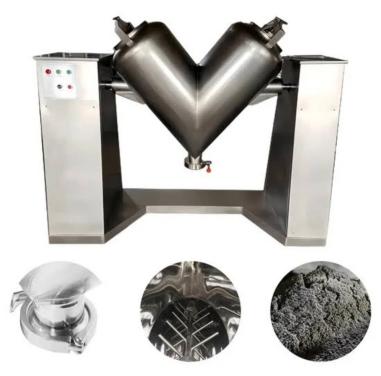
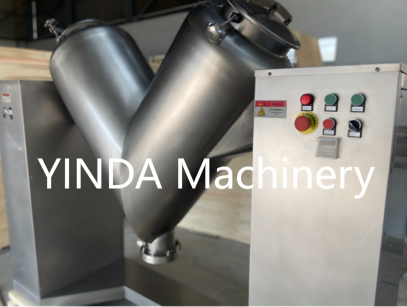
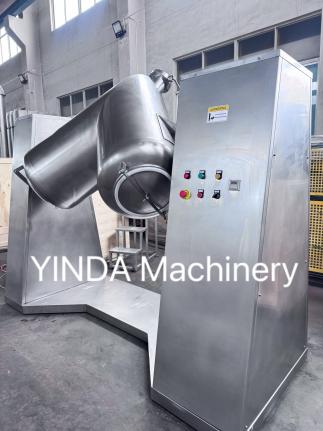
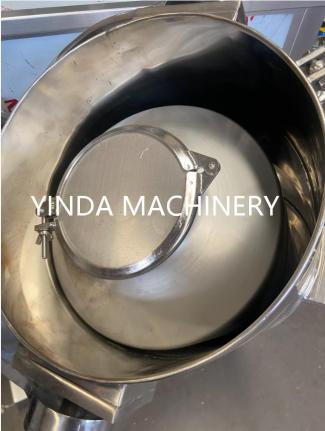
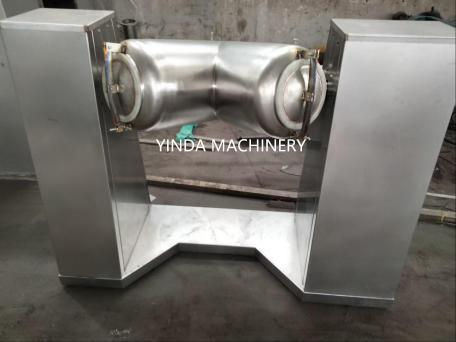
Yinda Machinery's YDV series V blender consists of two feed inlets, a mixing vessel, a discharge outlet, and an electrical control system. Its body is constructed from two welded cylindrical sections arranged in a V-shaped configuration.
During operation, the motor transmits power through a belt to a reducer. The reducer then transfers power through a coupling to rotate the V-shaped vessel continuously. As the vessel rotates, the materials repeatedly move upward and downward, creating a tumbling action that promotes mixing.
The V blender can be equipped with an additional forced mixing assembly for materials that are viscous or have poor flowability. This optional assembly helps intensify material movement and improve mixing uniformity.
Watch the related YINDA equipment video
Key Features of Yinda Machinery's YDV-V Blender
Mixing applications: Suitable for blending two or more types of dry powders or granules in pharmaceutical, food, chemical, and related industries.
Optional forced mixing: An additional mixing assembly can be installed to improve mixing performance for viscous or poorly flowing materials.
Stainless steel construction: Manufactured using stainless steel, with a design intended to meet GMP requirements.
Flexible operation: The vessel can be tilted through an angle range of 0° to 360°, with manually operated feed and discharge openings.
Practical loading and discharge: The feed inlet uses a quick-locking mechanism, while the discharge outlet uses a manual butterfly valve or pneumatic butterfly valve.
Typical filling ratio: The working volume generally accounts for approximately 30%鈥?0% of the vessel's total volume.
Source reference specifications; final model and performance should be confirmed for the actual material.
| Model | YDV-100 | YDV-200 | YDV-300 | YDV-500 | YDV-1000 |
|---|---|---|---|---|---|
| Volume(m3) | 0.1 | 0.2 | 0.3 | 0.5 | 1 |
| Mixing time(min) | 4-8 | 4-8 | 4-8 | 6-10 | 6-10 |
| Barrel speed(r/min) | 12 | 12 | 12 | 12 | 12 |
| Motor power(kw) | 0.1 | 0.1 | 1.5 | 2.2 | 4 |
| Forced agitator(kw) | 1.75 | 1.75 | 1.1 | 1.5 | 3 |
| Overall size(mm) | 1840*600*1430 | 2110*600*1675 | 2400*940*1890 | 2500*800*2000 | 3070*1240*2490 |
Watch the related YINDA equipment video
What Is a 3D Mixer?
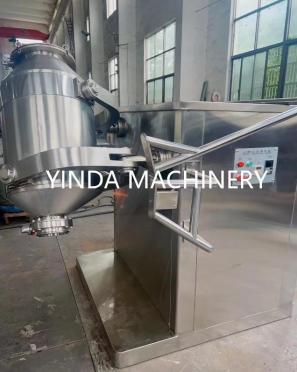
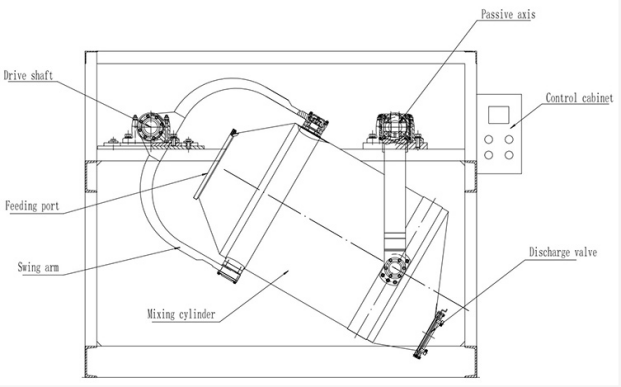
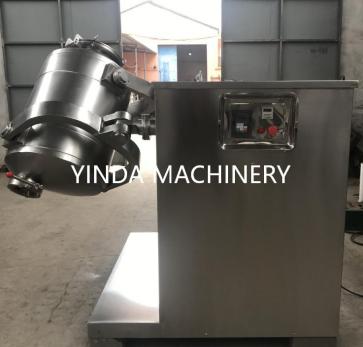
A 3D mixer is a powder mixing machine that uses multidirectional movement to promote material circulation and redistribution inside the mixing container. Unlike a conventional rotating vessel, a 3D mixer moves along multiple axes, creating numerous mixing paths within the container.
Yinda Machinery's YDSW series 3D mixers are designed for mixing dry powders and granules in the pharmaceutical, chemical, food, and related industries. They can handle materials with different specific gravities and particle sizes, helping achieve rapid and uniform mixing under suitable operating conditions.
The multidirectional movement allows materials to move from the center toward the ends of the container while also moving vertically. This repeated circulation and diffusion helps reduce mixing dead zones and supports a more uniform distribution of different components.
Yinda Machinery's 3D mixers can also be configured with interchangeable mixing containers. This design is useful when different materials require separate containers or when production processes require convenient container replacement.
Watch the related YINDA equipment video
Key Features of Yinda Machinery's YDSW-3D Mixer
Multidirectional mixing: Promotes material circulation and redistribution through movement along multiple axes.
Wide material compatibility: Suitable for dry powders and granules with different particle sizes and specific gravities.
Flexible process options: Depending on the material and process configuration, the mixer can also be used for certain wet鈥搘et and wet鈥揹ry mixing applications.
Interchangeable containers: Optional replaceable mixing containers can support different production requirements.
High loading efficiency: The stated loading efficiency can reach approximately 60%鈥?0%, depending on the material and operating conditions.
Short mixing time: Multidirectional movement supports rapid mixing and efficient material circulation.
Convenient cleaning and discharge: The container design facilitates material discharge and cleaning.
Enclosed mixing process: Materials are mixed inside a closed container, helping reduce dust generation and the risk of contamination of the materials and surrounding working environment.
Safety protection: A protective safety cage helps prevent personnel injuries during operation.
Source reference specifications; final model and performance should be confirmed for the actual material.
| Model | YDSW-50 | YDSW-100 | YDSW-200 | YDSW-300 | YDSW-400 | YDSW-500 |
|---|---|---|---|---|---|---|
| Volume of mixing barrel/L | 50 | 100 | 200 | 300 | 400 | 500 |
| Max. loading volume/L | 40 | 80 | 160 | 240 | 320 | 400 |
| Spindle speed, r/min | 8-12 | 8-12 | 8-12 | 8-12 | 8-12 | 8-12 |
| Motor power/kW | 1.1 | 1.5 | 2.2 | 4 | 4 | 5.5 |
| Overall dimension/mm | 1000×1400×1100 | 1200×1700×1200 | 1400×1800×1500 | 1800×1950×1700 | 1800×2100×1800 | 1900×2000×1950 |
| Weight/kg | 300 | 500 | 800 | 1000 | 1200 | 1300 |
Watch the related YINDA equipment video
V Blender vs. 3D Mixer: Key Differences
The main difference between a V blender and a 3D mixer lies in their movement patterns, loading efficiency, container configuration, and suitability for different material handling requirements.
A V blender is a practical choice for conventional dry powder and granule blending. Its rotating V-shaped vessel repeatedly divides and recombines the materials, making it suitable for many routine blending applications. When materials have poor flowability or require additional mechanical assistance, an optional forced mixing assembly can be installed.
A 3D mixer provides multidirectional movement that promotes circulation throughout the mixing container. Its higher stated loading efficiency and interchangeable container options can be advantageous for applications that prioritize container flexibility, space utilization within the vessel, and efficient material handling.
Source reference specifications; final model and performance should be confirmed for the actual material.
| Comparison Item | Yinda YDV V Blender | Yinda YDSW 3D Mixer |
|---|---|---|
| Mixing principle | Rotation and tumbling in a V-shaped vessel | Multidirectional movement along multiple axes |
| Typical materials | Dry powders and granules | Dry powders and granules; selected wet mixing applications depending on configuration |
| Material circulation | Repeated upward and downward movement | Multidirectional circulation and redistribution |
| Typical working/loading ratio | Approximately 30%鈥?0% | Approximately 60%鈥?0% |
| Optional internal mixing | Forced mixing assembly available | Mixing configuration can be customized |
| Container options | V-shaped mixing vessel | Interchangeable mixing container available |
| Cleaning and discharge | Manual butterfly valve or pneumatic butterfly valve; cleaning procedure depends on configuration | Designed for convenient discharge and cleaning |
| Safety features | Waterproof control box, digital timer, overload protection | Protective safety cage |
| Construction | Stainless steel; designed to meet GMP requirements | Configuration and material requirements can be specified |
| Suitable selection priorities | Conventional dry blending and optional forced mixing | Multidirectional mixing and flexible container handling |
Technical note: The stated loading ratios are based on the supplied product information. Actual operating fill levels and performance should be confirmed for the specific material, model, and process requirements.
Mixing Principle: Why Does the Movement Pattern Matter?
The mixing mechanism affects how materials circulate, redistribute, and interact inside the vessel. Understanding this difference helps buyers evaluate which machine is better suited to their production requirements.
How a V Blender Mixes Materials
A V blender rotates its V-shaped vessel continuously. During rotation, the material bed is repeatedly divided into different sections and recombined as the vessel changes position. This repeated tumbling action promotes the redistribution of particles throughout the batch.
For applications involving materials with poor flowability, Yinda Machinery can equip the V blender with an additional forced mixing assembly. The assembly introduces additional mechanical movement to help improve mixing uniformity.
How a 3D Mixer Mixes Materials
A 3D mixer moves its container in multiple directions rather than relying solely on a single rotational movement. This movement causes materials to circulate between different regions of the container, including movement from the center toward the ends and from the upper region toward the lower region.
The resulting circulation and diffusion create multiple opportunities for particles to redistribute within the batch. This makes a 3D mixer an attractive option when multidirectional material movement is a priority.
The actual mixing result depends on material properties, particle size, specific gravity, loading ratio, mixing time, and equipment configuration. Mixing trials are recommended when uniformity requirements are critical.
Applications: Which Mixer Is Suitable for Your Industry?
Both V blenders and 3D mixers are used in powder processing industries. The appropriate choice depends on the material characteristics and the requirements of the production process.
Pharmaceutical Industry
YDV series V blenders can be used to blend pharmaceutical powders and granules. Their stainless steel construction and GMP-oriented design make them relevant to pharmaceutical processing requirements.
Yinda Machinery's YDSW series 3D mixers are also designed for pharmaceutical powder mixing. Their multidirectional movement can support the distribution of different powder components throughout the mixing container.
The final equipment selection should consider the required blend uniformity, cleaning procedures, production capacity, and applicable quality requirements.
Food Industry
In food processing, powder mixing machines are used for blending dry ingredients and granules. V blenders provide a conventional tumbling-based mixing solution, while 3D mixers offer multidirectional mixing and optional interchangeable containers.
The appropriate choice depends on the ingredients, cleaning requirements, batch size, and desired mixing performance.
Chemical Industry
Chemical powder processing may involve materials with different particle sizes, specific gravities, and flow properties. Both V blenders and 3D mixers can be considered for suitable dry mixing applications.
Where a material requires additional mechanical mixing assistance, a V blender can be equipped with an optional forced mixing assembly. Where multidirectional circulation or interchangeable containers are important, a 3D mixer may be more suitable.
Other Powder Processing Applications
These machines can also be evaluated for other industries that require the mixing of dry powders or granules. For specialized materials, equipment compatibility and the required mixing performance should be confirmed before selecting a model.
How to Choose Between a V Blender and a 3D Mixer
There is no single powder mixing machine that is ideal for every application. The best choice depends on the material, production process, and required mixing performance.
Choose a V blender when:
• Your primary application involves conventional dry powder or granule blending.
• You prefer a rotating V-shaped vessel with a straightforward tumbling-based mixing principle.
• Your materials require additional mechanical assistance and an optional forced mixing assembly is appropriate.
• Your typical working volume ratio is compatible with the V blender's approximate 30%鈥?0% range.
Consider a 3D mixer when:
• Multidirectional material circulation is important to your mixing process.
• You need a higher stated loading efficiency, with the YDSW series specified at approximately 60%鈥?0%.
• Different products require interchangeable mixing containers.
• You want to evaluate an enclosed mixing configuration that supports dust reduction and convenient cleaning.
• Your application requires the assessment of different powder and granule characteristics, including different particle sizes and specific gravities.
• Before making a final decision, consider conducting a material mixing test. Factors such as particle size, bulk density, flowability, moisture content, loading ratio, and required blend uniformity can affect the result.
Contact Yinda Machinery with your material and production details to discuss the most suitable equipment configuration.
Why Choose Yinda Machinery?
Selecting a powder mixing machine involves more than comparing equipment dimensions or nominal capacity. Buyers also need to consider the mixing mechanism, material compatibility, operating requirements, cleaning procedures, and available customization options.
Yinda Machinery offers both YDV series V blenders and YDSW series 3D mixers, giving customers options for different powder and granule mixing requirements.
Our equipment configurations include practical features such as forced mixing options for V blenders, interchangeable mixing containers for 3D mixers, and safety-oriented operating components.
By evaluating the application and material characteristics, customers can identify a suitable mixing solution rather than relying on machine type alone.
Whether you are planning a new powder processing line or upgrading an existing production process, Yinda Machinery can help you evaluate the equipment options for your application.
Are you comparing a V blender and a 3D mixer for your production process?
Contact Yinda Machinery today to discuss your powder mixing requirements and request a quotation.
Request a customized powder processing solution
Send the raw material condition, target particle size, hourly capacity, local electrical supply and construction requirements for project evaluation and material testing.
Dennie Yuan | Powder Processing Solution Specialist
Email: dennie@yindamachinery.com
WhatsApp / WeChat: +86-13914192807
Website: https://yindapowdertec.com/
Final machine model, capacity, fineness and process configuration are subject to project review and material testing.